
Two tone wall paint changes a room’s proportions or carves out a focal zone with just a roller and some tape. The effect depends less on the colors you pick and more on how clean your dividing line ends up, which means preparation and edge control matter more than paint choice. Singapore homeowners also need to check that any interior paint meets the country’s 2026 formaldehyde rule before buying. What follows covers the design ideas worth copying, the exact steps to paint a crisp line, and when it makes sense to hand the job to a professional instead.
TL;DR:
- Proper surface preparation and edge sealing are crucial to achieving crisp, professional-looking two tone wall lines, not just paint color choices.
- Using a level, sealing tape edges with a layer of the first color, and removing tape while paint is tacky are essential steps to prevent bleeding and uneven lines.
- Placement of the dividing line should align with architectural features or furniture to create a cohesive and intentional design effect.
- In Singapore, all interior paints must meet the 2026 formaldehyde regulation, so buyers should check labels before purchasing.
- Hiring a professional guarantees sharper edges, thorough prep, and better overall results, especially for full-room jobs or resale preparation.
Table of Contents
- Two Tone Walls Ideas Worth Copying
- How Do You Paint a Wall in Two Colors?
- How Do I Choose Colors and Placement for a Two Tone Wall?
- What Tools and Prep Work Do You Actually Need?
- Why Edge Control Matters More Than Color Choice
- Should You DIY or Hire a Painter for a Two Tone Wall?
- Get a Two Tone Finish Without the Guesswork
- Where to Verify These Details
- Sources
- FAQ
Two Tone Walls Ideas Worth Copying
The split you choose should match the room’s ceiling height, furniture layout, and how much drama you want on the wall. A few combinations consistently work well across different home types.
- Lower third dark, upper two thirds light: grounds the room and hides scuffs near furniture and skirting, while the lighter top keeps the ceiling feeling tall.
- Upper third dark, lower light: creates a cozier, more intimate feel, especially in bedrooms where you want the space to feel enclosed rather than airy.
- Half and half split at chair-rail height: a classic proportion that reads as intentional, particularly when the line lands where a picture rail or chair rail would naturally sit.
- Vertical color-block on one section: works well in an alcove, behind a headboard, or flanking a doorway, and reads as a feature rather than a full room treatment.
- Tone-on-tone pairing: two shades from the same color family (say, a soft sage and a deeper forest) for subtlety that suits living rooms and open-plan spaces.
- High-contrast pairing: opposite or complementary hues for a bolder statement, better suited to a single accent wall than four walls in a small room.
Each of these works because the line lands somewhere logical. Aligning the dividing line with an existing architectural feature, like a picture rail or the top of a headboard, makes the split look designed rather than arbitrary. If your room has a media wall or built-in cabinetry, matching the color break to that structure gives the same polished result; design references for media wall layouts show how the color line and the furniture line can work together instead of competing.
How Do You Paint a Wall in Two Colors?
Getting a crisp two tone finish comes down to sequence and patience more than skill. Rushing the tape step is where most DIY attempts fall apart.
- Measure and mark your line. Use a level or laser level and reference the ceiling at multiple points along the wall, since manual tape measurements tend to drift on longer walls.
- Paint the first color, usually the lighter one, across the whole section. Let it dry fully and extend the paint slightly past where your line will sit.
- Mark and tape the dividing line. A chalk line works well for long, straight runs; re-measure if it’s been more than a day since your first step.
- Seal the tape edge. Press the tape down with a putty knife or an old credit card, then paint a thin coat of the first color directly over the tape edge. Sealing the tape this way is what stops the second color from bleeding underneath.
- Paint the second color, working carefully near the taped edge with an angled brush before rolling the rest of the section. Apply a second coat if coverage looks uneven.
- Remove the tape at the right moment, pulling it back on itself at roughly a 45 degree angle while the paint is still slightly tacky rather than fully cured.
Pro Tip: If a little paint still bleeds through, don’t panic. Score along the line with a sharp blade before pulling tape, and touch up any stray marks with a small artist’s brush rather than repainting the whole section.
How Do I Choose Colors and Placement for a Two Tone Wall?
Color and placement decisions work together more than most guides admit. The same pair of colors can make a room feel bigger or smaller depending purely on where the line sits.
- A lighter upper section tends to lift the perceived ceiling height, while a darker upper section visually lowers it, so choose placement based on whether your room needs more height or more intimacy.
- Painting the ceiling to match the upper wall color extends that lifted feeling even further in a low-ceilinged room.
- Tone-on-tone pairings feel calm and cohesive; complementary or opposite hues create energy and work best as a single feature rather than every wall.
- Darker lower sections hide scuffs, hallway traffic marks, and furniture rubs better than light ones, which matters in high-use rooms.
- Keep the same sheen across both colors for a seamless look, or mix matte above with a satin lower band for subtle texture and easier wipe-down cleaning.
If you’re unsure which shades will actually read well under your room’s lighting, a simple color-testing method for Singapore homes helps narrow choices before you commit to a full gallon. Door color matters here too. Pairing wall tones with the right door finish keeps the whole room from feeling disjointed once the paint dries.
What Tools and Prep Work Do You Actually Need?
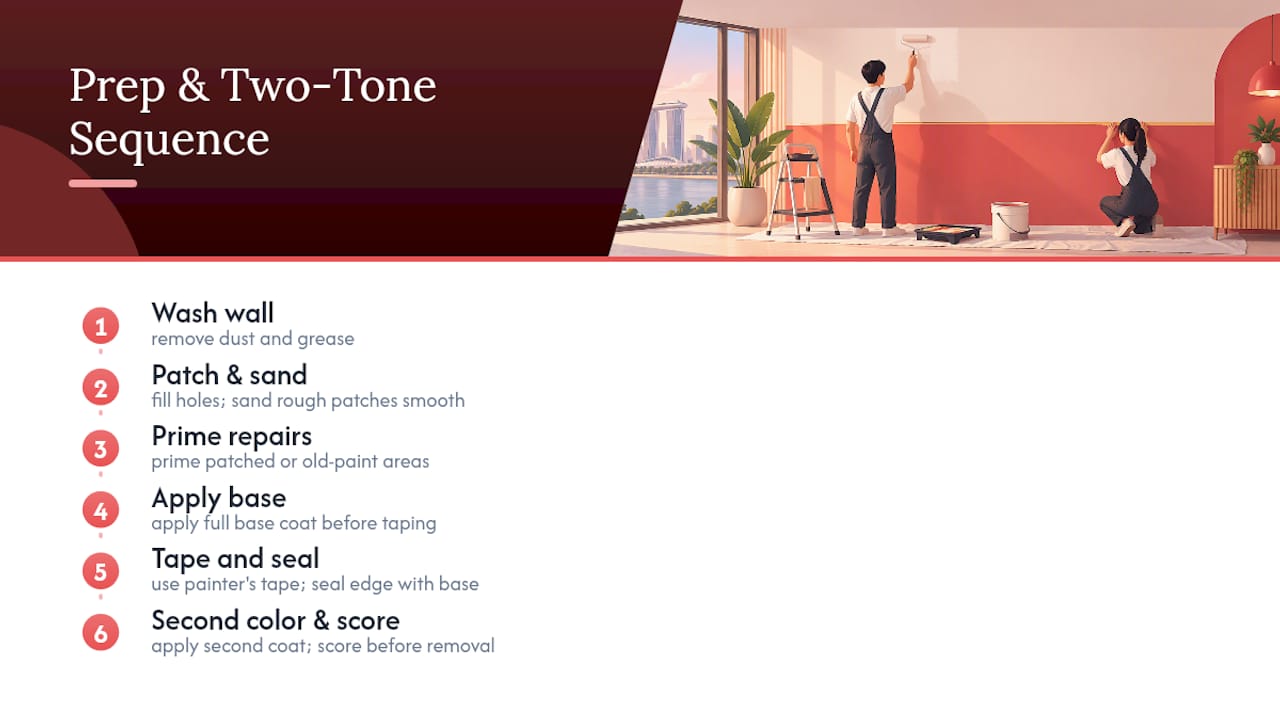
Most two tone paint failures trace back to skipped prep, not bad color choices. Clean the wall, patch any holes or dents, sand rough patches smooth, and prime areas where old paint or repairs would otherwise show through.
Your minimum kit: measuring tape, pencil, a spirit or laser level, chalk line, painter’s tape rated for clean release, an angled brush, mini rollers, a standard roller and tray, and a putty knife or old credit card for sealing tape edges.
To prevent bleed, seal every taped edge with a thin coat of the base color before applying the second color, and score the tape line before removal rather than yanking it off cold. Work in a ventilated room, and confirm the paint can is labeled for interior use. From January 1, 2026, interior paints sold in Singapore must contain less than 0.01% formaldehyde by weight, so check the label rather than relying on marketing terms like “low-odor” alone.
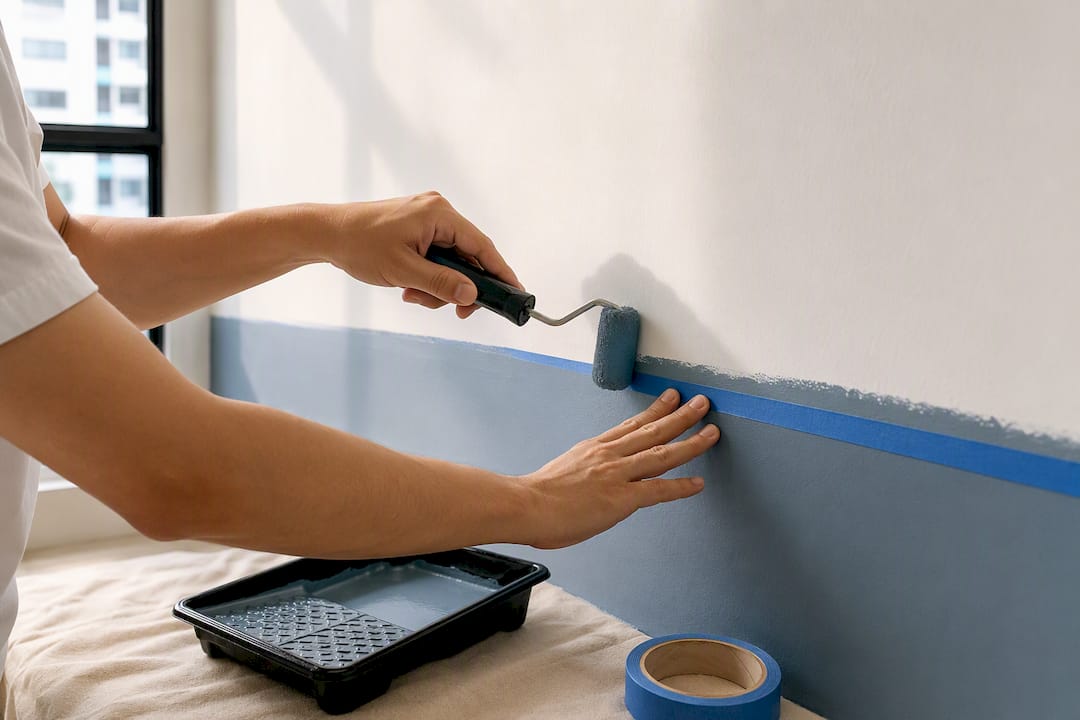
Before you tape anything, it helps to wash the wall properly first since dust and grease under tape are a common cause of peeling paint later.
Why Edge Control Matters More Than Color Choice
Professional painters consistently point to one factor above all others when judging a two tone job: how clean the dividing line looks up close. Color pairing gets the compliments from across the room, but edge control is what holds up under a closer look.
Measured lines, properly sealed tape edges, and careful tape removal are what separate a professional-looking two tone wall from a DIY attempt that reads as slightly off. No color combination compensates for a wavy or bled line.
Singapore’s incoming formaldehyde limit adds another layer buyers should check before purchase. Government guidance confirms that ventilation and label directions still matter even with compliant paint. Some professional painting companies build their process around this same principle, treating surface prep and precise masking as the foundation of every job, often backed by a warranty on the finished work.
Should You DIY or Hire a Painter for a Two Tone Wall?
A single accent wall with a simple horizontal or vertical split is a reasonable weekend DIY project if you’re comfortable with a level and painter’s tape. For full rooms, resale prep, or a guaranteed flawless line, a professional brings sharper edge control, proper surface prep, and project oversight you won’t easily replicate solo.
Get a Two Tone Finish Without the Guesswork
If measuring, taping, and sealing edges sounds like more precision than you want to gamble on a repainted living room, hiring it out removes that risk entirely. Some professional painting companies handle the full job with all-inclusive pricing that typically covers labor, quality paint, furniture protection, and cleanup, so there is no separate line item that shows up later.
Jobs often include meticulous surface prep and project management oversight from start to finish, backed by a warranty on the finish. That combination matters most for homeowners prepping a unit for resale or anyone who wants a two tone wall with genuinely straight lines rather than a hopeful DIY attempt. HDB owners can review the HDB painting packages, which start at $600 for the Basic Package and scale up through Enhanced and Premium tiers depending on prep and finish level. Condo owners have a parallel set of condo packages built the same way. Get in touch for a quote and let a project manager map out your two tone wall before the first coat goes on.
Where to Verify These Details
Confirm Singapore’s formaldehyde rule directly through the NEA advisory on interior building products. For technique and design inspiration beyond this guide, Better Homes & Gardens and This Old House both cover additional two tone paint ideas worth browsing.
Sources
- NEA advisory: Formaldehyde in interior building products
- Two tone paint ideas and technique emphasis — Livingetc
- This Old House: 6 tips for color-block paint and preventing bleed
- Better Homes & Gardens: Two-tone wall ideas and placement guidance
FAQ
Are two tone walls still in style?
Yes. Two tone walls remain a popular, low-cost way to add dimension to a room without committing to wallpaper or a full accent wall in one bold color. Designers continue to recommend varying the split height as a way to keep the look feeling current rather than dated.
How do you two tone paint a wall?
Measure and mark your dividing line, paint the lighter color first and let it cure, then tape the line and seal the tape edge with a thin coat of the first color before painting the second color. Removing the tape at a 45 degree angle while the paint is still slightly tacky prevents peeling and keeps the line crisp.
Do two tone walls make a room look bigger?
They can, depending on placement rather than color alone. A lighter upper section tends to lift the perceived ceiling height and make a room feel taller, while a darker upper section visually lowers it and makes the space feel more intimate.
How do I paint a wall in two colors without the line bleeding?
Seal every taped edge with a thin coat of the base color before applying the second color, since this thin seal coat catches any bleed instead of letting the new color creep underneath the tape. Removing tape before the paint fully hardens, and scoring the line first with a blade, also keeps edges from tearing or peeling.
How much does a professional two tone paint job cost in Singapore?
Pricing depends on the property type and paint package chosen. Homeowners can review current package pricing and the specific HDB painting packages for exact ranges by unit type and finish level.