
Choose muted or dusted blues, sage greens, warm neutrals, dusty blush pastels, or a selective deep tone for a feature wall. Favor slightly warmer, slightly more saturated versions than cool-climate swatches suggest, because Singapore’s tropical daylight intensifies color and can wash out flat grays. Test large swatches directly on your wall before committing, and call in a professional if your walls show signs of moisture or previous peeling.
TL;DR:
- Use slightly warmer and more saturated shades than cool-climate swatches to counteract Singapore’s tropical daylight and prevent colors from washing out.
- Choose muted or dusty blues, sage greens, or deep tones for small bedrooms and feature walls, considering room orientation and lighting conditions.
- Test large color patches on your actual wall during different times of day, under various lighting, to identify undertone shifts before committing to a color.
- Opt for low-VOC, low-odor paints and consider professional painters to ensure surface preparation and proper finish, especially in humid, moisture-prone environments.
- Maintain painted walls regularly by gentle cleaning and monitor for signs of trapped moisture or mold, which are common issues in Singapore’s humid climate.
Table of Contents
- Bedroom colour families and palette ideas that work in Singapore
- How Singapore light and unit orientation affect colour choices
- Colour intensity, saturation and finish: what actually supports sleep
- How to test paint samples effectively in your bedroom
- When to hire a professional painter in Singapore and what they handle
- Choosing eco-friendly and low-VOC paints for cleaner indoor air
- Maintenance and cleaning for painted walls in Singapore’s humid climate
- Trends in bedroom paint colors shaping Singapore interiors
- What Singapore homeowners get wrong about bedroom color
- How 5starpainting gets your bedroom colour and finish right the first time
- Sources
Bedroom colour families and palette ideas that work in Singapore
Most Singapore bedrooms benefit from one of five reliable palette families. Each behaves differently under tropical light and fits a different kind of room.
- Muted or dusty blues create a settled, restful mood and suit a small master bedroom facing east or north. Pair with light oak or whitewashed wood trim to keep the room from feeling cold.
- Sage and soft greens work well in guest rooms and reading corners, pairing naturally with rattan, cane, and warm timber accents common in Singapore interiors.
- Warm neutrals and greige give you flexibility across a whole flat, especially where the bedroom connects visually to a living space painted in a similar family.
- Dusty blush and soft pastels suit a child’s room or a shared bedroom, adding warmth without the sweetness of a true pink.
- Deep moody tones like charcoal, forest green, or ink blue work best confined to a single headboard wall, where they add drama without swallowing a small footprint.
Dulux’s 2026 Rhythm of Blues collection, built around three related tones named Free Groove, Mellow Flow, and Slow Swing, is a useful reference point. The trio shows how slightly different blues can be adapted for tropical daylight, either layered for calm or deepened for a cocooning effect in a single room.
How Singapore light and unit orientation affect colour choices
Singapore’s daylight is intense and fairly consistent year round, which means colors read brighter and more saturated indoors than the same swatch might look in a temperate climate. Most HDB and condo units also rely on warm-toned LED lighting in the evening, which shifts a cool blue toward gray or nudges a neutral toward yellow after sunset.
Unit orientation changes this further. Empire Works’ room-by-room guide notes that west-facing units catch intense, warming afternoon sun, which can push a pale gray toward a muddy beige by late afternoon. North and east-facing bedrooms get gentler, cooler light through most of the day, so they can carry slightly deeper or cooler tones without feeling flat.
- North or east-facing rooms: cooler blues and greens read cleanly since the light stays soft.
- South-facing rooms: most neutrals and pastels behave predictably through the day.
- West-facing rooms: favor warmer undertones or slightly grayed versions of your chosen color to offset the late-day heat in the light.
For a small bedroom, a two-tone approach, a deeper shade on the headboard wall against three lighter walls, adds depth without shrinking the room visually, a technique local design guides recommend for tight HDB footprints.
Pro Tip: If your bedroom runs on warm 2700K bulbs instead of a cooler 3000K or 4000K, your paint color will look noticeably warmer at night than during the day. Understanding how bulb temperature affects color before you paint saves a repaint later.
Colour intensity, saturation and finish: what actually supports sleep
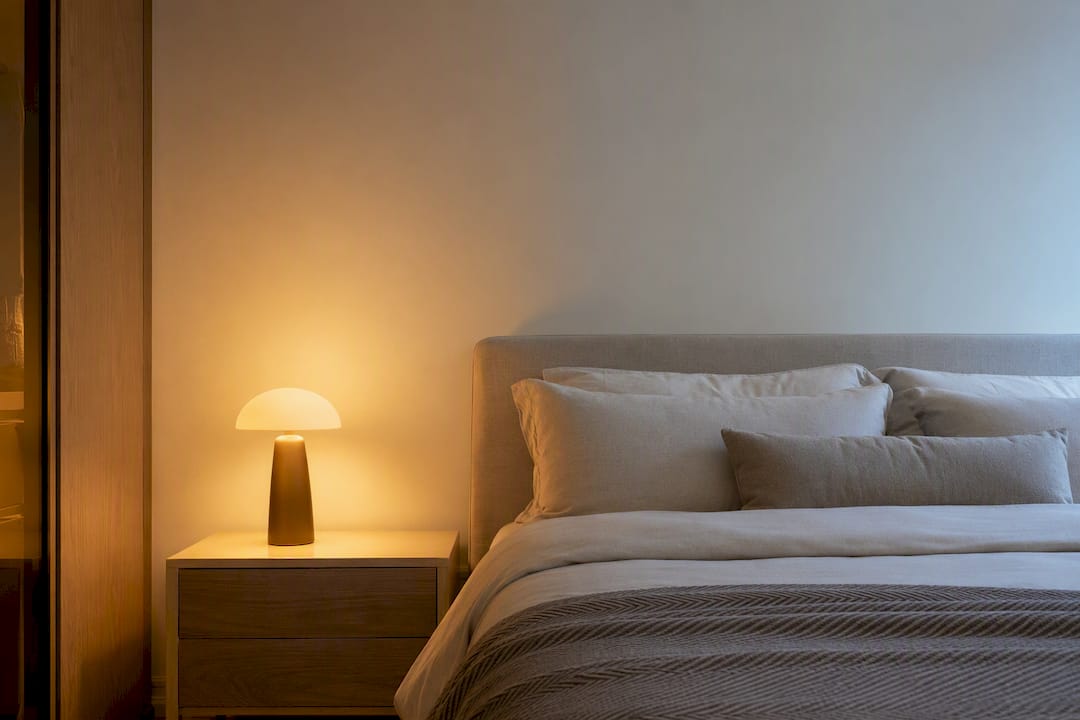
Intensity matters as much as the hue itself. A fully saturated teal and a dusted, grayed-down version of the same teal create very different moods, and the dusted version is almost always the better choice for a room meant for rest. Local designers caution against copying palettes straight from cooler-climate mood boards, since Nikki Hunt’s observations on tropical light suggest a clean, slightly saturated tone holds its character here better than a flat gray does. Desaturated tones reduce visual stimulation, and design roundups on calming bedroom colors consistently point to muted blues, sage, and warm neutrals as the categories that read as restful rather than sterile.
Finish matters just as much as color:
- Matte or flat finishes suit a cocooning bedroom feel and hide minor wall imperfections well.
- Eggshell or satin finishes make sense on a wall near a headboard or door frame, where fingerprints and scuffs need occasional wiping.
- Gloss belongs on trim and doors, not on main bedroom walls, where it can highlight every uneven patch job.
Look for low-odor, low-VOC formulations too. Air-conditioned Singapore bedrooms trap indoor air longer than naturally ventilated rooms, so a lower-emission paint noticeably improves how a freshly painted room smells and feels in the first few days.
How to test paint samples effectively in your bedroom
A tester pot on a scrap of cardboard tells you almost nothing useful. Nippon Paint’s own guidance recommends viewing color in a real room setting rather than trusting a screen preview, and a proper on-wall test takes this further.
- Paint an A3-sized patch, or roughly 60cm by 40cm, directly on the actual wall with two full coats.
- Check it in the morning, again in late afternoon, and once more under your bedroom’s lamps at night.
- Look for undertone shifts. A gray that leans blue in daylight might lean green under warm LED light.
- Hold a swatch of your bedsheet or a piece of your wood furniture against the patch to see how it interacts with real textiles and finishes.
- If the color shifts dramatically across all three lighting checks, discard it. A hue that only works in one light isn’t worth the risk.
When to hire a professional painter in Singapore and what they handle
A DIY repaint works fine for a fresh, well-maintained wall. It becomes a poor bet the moment you see bubbling paint, dark spots near the ceiling, or a wall that’s felt slightly damp after heavy rain. Singapore’s humidity means moisture trapped behind old paint layers causes far more repaint failures than a poor color choice ever does.
A professional job typically covers surface preparation, hole patching, a moisture and mould assessment, priming, a two-coat finish, furniture protection, and post-job cleanup, usually overseen by one project manager who stays with the job from start to finish.
- Ask which paint brand they use and whether it’s genuine, not a rebranded budget line.
- Ask about warranty length and what it actually covers.
- Confirm a dedicated project manager will be assigned, not a rotating crew.
- Confirm furniture protection and cleanup are included, not billed as extras.
Pro Tip: Get the full cost breakdown for painting a home in Singapore before comparing quotes, so you know exactly what should be included in an all-inclusive price.
Choosing eco-friendly and low-VOC paints for cleaner indoor air
Most Singapore bedrooms stay sealed for hours at a stretch under air conditioning, which means anything a paint releases into the air lingers longer than it would in a naturally ventilated room. That makes VOC content, short for volatile organic compounds, worth checking before you commit to a color.
Look for paints explicitly labeled low-VOC or low-odor rather than assuming a premium price tag means a cleaner formulation. Several manufacturers now market low-odor and formaldehyde-reducing variants specifically for city apartments, a trend reflected in broader industry sustainability commitments from major paint groups operating in the region.
A few practical checks help:
- Ask your painter or retailer for the technical data sheet, which lists VOC content in grams per liter rather than relying on marketing language alone.
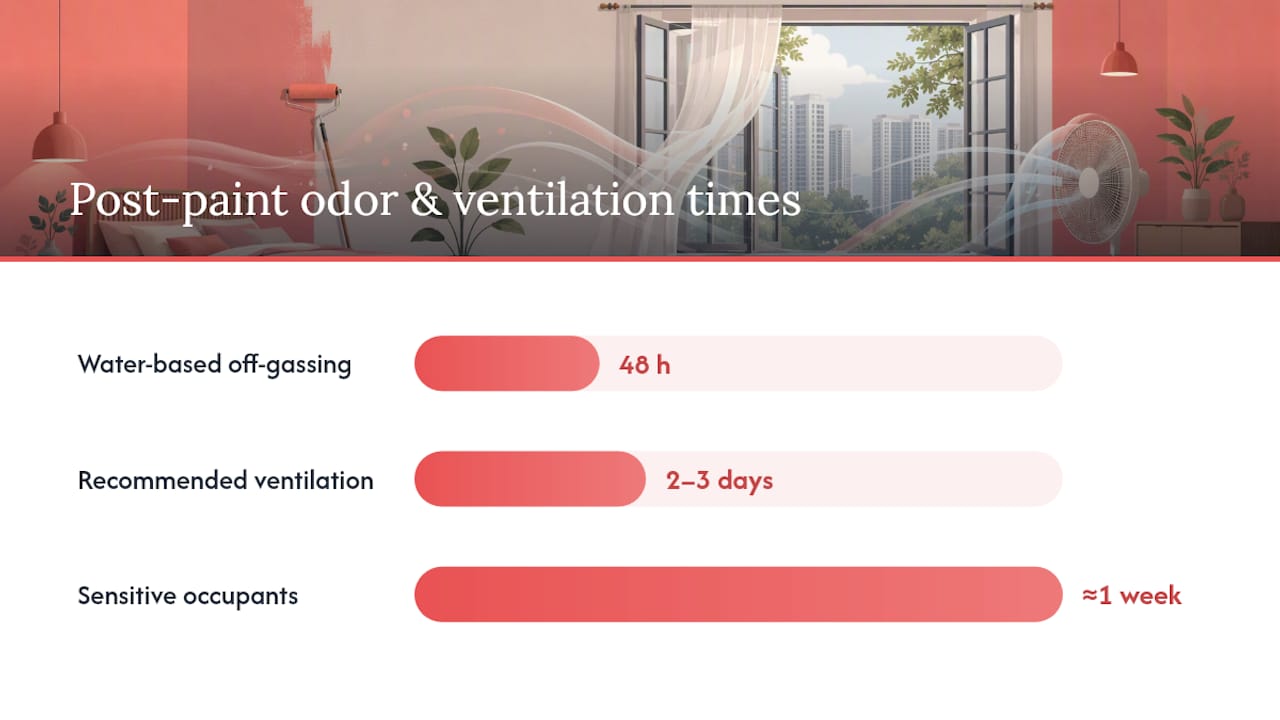
- Favor water-based formulations over solvent-based ones for interior bedroom walls; they generally off-gas faster and smell less intense in the first 48 hours.
- Ventilate the room as much as possible for the first two to three days after painting, even with air conditioning running, to help any residual odor clear faster.
- If anyone in the household has respiratory sensitivities, prioritize a certified low-VOC line over a color preference, since the wrong finish can make a small bedroom uncomfortable to sleep in for the first week.
None of this changes which color looks best on your wall. It changes how the room feels to breathe in for the weeks right after the job finishes, which matters more in a bedroom than almost any other room in the home.
Maintenance and cleaning for painted walls in Singapore’s humid climate
Singapore’s humidity works against painted walls year round, not just during the rainy months. Moisture in the air softens paint film over time, and any wall backing onto a bathroom or kitchen faces a slightly higher risk of localized mould if ventilation is poor.
Wipe walls down with a slightly damp microfiber cloth every few weeks rather than a soaked sponge, which can push moisture into hairline cracks. For matte finishes, stick to plain water; a satin or eggshell wall near a headboard can handle a mild detergent solution for the occasional scuff mark. Avoid abrasive scrubbing on any finish, since it burnishes the surface and leaves a visible shiny patch that never quite matches the surrounding wall again.
Check corners and areas near windows or air-conditioning units every few months for early signs of bubbling, discoloration, or a musty smell. These are the first indicators of trapped moisture behind the paint layer, and catching the issue early means a small patch repair instead of a full repaint. A wall that was properly primed and prepped before painting resists this far better than one that was painted over an existing damp patch, which is one reason surface preparation matters as much as color selection in a tropical climate.
If you’re recalculating how much paint or material a touch-up will need, a quick reference on how much paint covers a given wall area helps avoid buying more than a small repair actually requires.
Trends in bedroom paint colors shaping Singapore interiors
Singapore’s bedroom palettes have moved away from the flat, cool grays that dominated minimalist interiors a few years ago. Homeowners are leaning into tones with more warmth and character, colors that still feel calm but don’t wash out under tropical daylight the way a stark gray tends to.
Dusty, muted blues remain one of the strongest trends, often used across an entire small bedroom rather than confined to a single wall, echoing the layered approach in Dulux’s Rhythm of Blues palette mentioned earlier. Sage and other soft greens have grown alongside a broader shift toward natural materials, rattan, cane, and light timber, in Singapore interior styling, since these tones pair naturally with organic textures.
Warm neutrals and greige have replaced pure white as the default “safe” choice for renters and resale-focused homeowners, largely because they photograph better and read as intentional rather than blank. And deep, moody tones on a single feature wall, ink blue, deep forest, or charcoal, continue gaining ground in condo bedrooms where ceiling height and natural light can support a bolder move without making the room feel closed in.
What Singapore homeowners get wrong about bedroom color
The most common mistake I see is homeowners pulling a palette straight from a Pinterest board shot in a Scandinavian apartment, then wondering why the same gray looks flat and lifeless once it’s on their own wall. Singapore’s light is simply stronger and warmer, and a swatch that looked sophisticated on a screen in a cooler climate often reads as sterile here.
The second mistake is testing color on a tiny paint chip instead of a real patch on the actual wall. I’ve seen a small HDB master bedroom transformed by a two-tone approach, a dusty blue headboard wall against warm greige on the remaining three, chosen only after the homeowner tested both colors side by side across a full day. That patience made the difference between a room that felt considered and one that felt like a guess.
— Fabian
How 5starpainting gets your bedroom colour and finish right the first time
Picking the right dusty blue or warm greige is only half the job. Getting it onto your walls evenly, over properly prepped surfaces that won’t peel in six months, is the other half, and it’s where most DIY repaints run into trouble. A professional painting company with extensive experience handles this kind of work for Singapore homeowners, often offering all-inclusive pricing that covers paint, furniture protection, cleanup, and a warranty, with no hidden fees added after the quote.
Many professional painting jobs are overseen by a single project manager who manages prep work, including moisture checks and hole patching, to help the finish hold up in Singapore’s humidity instead of bubbling within a year. If you’re painting a single bedroom as part of a larger HDB refresh, a small DIY test patch still makes sense for choosing color. But once you’re ready to commit to full walls, especially in a room with any sign of past dampness, hiring a professional protects both the finish and your time. Get a quote for HDB painting services or explore condo painting packages to see what’s included before your next repaint.
Sources
- Set the pace with paint: How colour choices shape the way you live | Home & Decor Singapore
- How to Choose Paint Colours for Your HDB: A Room-by-Room Guide | Empire Works
- Find Your Colour – White | Nippon Paint Singapore
- Gorgeous HDB bedroom colour trends — Prestige Affairs
One Response