
Lead-based paint can still exist in older Singapore homes, even though the National Environment Agency has capped new paint at 90 ppm total lead content since January 2022. If your walls have layers painted before that rule, don’t sand, scrape, or drill into suspect surfaces. Arrange a test kit, a field screening, or a professional assessment before you touch anything.
TL;DR:
- Testing older paint for lead requires a field screening or laboratory analysis, as DIY swab tests can produce false negatives and lack accuracy.
- Lead dust from disturbed paint poses the main health risk, especially to children and pregnant women, since it can be ingested through everyday contact.
- The current Singapore regulation limits new paint to 90 ppm of lead, but older layers may still contain higher concentrations that pose ongoing hazards.
- Encapsulation can be a safe, cost-effective method on intact surfaces, while removal and proper disposal are necessary for flaking or damaged paint above safety thresholds.
- Professional lead paint remediation involves containment, HEPA filtration, and verified clearance testing, and DIY handling should be limited to sampling in non-disturbed areas.
Table of Contents
- How to Tell if Paint Contains Lead in Singapore
- Why Dust, Not Paint, Is the Real Danger
- What Does the NEA 90 PPM Rule Actually Mean for You?
- Encapsulation, Removal, or Replacement: What Are Your Options?
- How Do Professionals Handle Lead Paint Safely?
- When Should You Call in a Professional?
- DIY Lead Paint Testing: Step-by-Step for Singapore Homes
- How Do You Dispose of Lead Paint Waste in Singapore?
- A Practical Action Plan for Homeowners
- Where to Verify Singapore’s Lead Paint Rules
- Sources
- FAQ
How to Tell if Paint Contains Lead in Singapore
You have three practical ways to check, and they differ a lot in cost and precision. A DIY swab test kit gives you a quick color-change reaction on a paint chip or surface. It’s useful as a first screen, but it can throw false negatives on paint that’s been coated with several newer layers, and it won’t tell you the actual lead concentration.
Portable XRF (X-ray fluorescence) screening is the next step-up. Contractors and building inspectors use handheld XRF devices to read lead content directly through paint layers without cutting into the wall, and this method has been used in local Singapore housing evaluations to assess legacy paint. It’s fast and non-destructive, though accuracy can vary depending on surface texture and paint thickness.
For a legally defensible number, or before a major renovation, send a paint chip sample to a laboratory for exact ppm results. This is the method to use if you’re making a removal-versus-encapsulation decision based on cost.
Whichever method you choose:
- Never sand, dry-scrape, or heat-strip a surface just to collect a test sample.
- Take small chip samples with a wet-wipe technique to limit dust.
- Test in multiple rooms if your flat was painted in different renovation eras.
- Keep children and pets out of the room while sampling.
Why Dust, Not Paint, Is the Real Danger
Intact, unbroken lead paint sitting quietly on a wall is not an emergency. The risk comes from disturbance: sanding, scraping, drilling, or even ordinary wear that flakes and peels old paint releases fine lead dust that settles on floors, furniture, and hands.
Who’s most at risk: Children under six absorb lead far more efficiently than adults and are prone to hand-to-mouth contact with dust and paint chips. Pregnant women pass lead through the placenta, affecting fetal brain development. Adults face lower but real risks, including elevated blood pressure and kidney strain, especially during hands-on renovation work.
Practical precautions matter more than panic. Wet-wipe surfaces instead of dry-dusting or sweeping. Keep kids out of any room under renovation. Wash hands and clothes after contact with older painted surfaces. Skip DIY sanding entirely on pre-1990s paint until you know what’s underneath it.
What Does the NEA 90 PPM Rule Actually Mean for You?
Since 3 January 2022, the NEA has enforced a rule under the Environmental Protection and Management Act: paints manufactured, imported, or sold for local use cannot exceed 90 parts per million total lead concentration. The rule applies to retail and trade paints sold today, and manufacturers must meet labeling requirements confirming compliance. You can check the NEA’s hazardous substances page for the broader policy framework this sits within.
A few things to keep in mind as a homeowner:
- Certain industrial coatings, like zinc anti-corrosion paints and copper anti-fouling marine paints, are exempt because of their specialized function.
- The 90 ppm limit governs new paint sold from 2022 onward. It does not retroactively strip lead from paint already on your walls.
- If your HDB flat or condo was last repainted decades ago, older layers underneath current paint may still carry lead concentrations well above today’s limit.
That last point is the one most homeowners miss. Buying compliant paint for your next repaint doesn’t protect you from what’s already on the wall beneath it.
Encapsulation, Removal, or Replacement: What Are Your Options?
Once testing confirms lead paint, you have three realistic paths, and the right one depends on the paint’s condition and what you’re planning to do with the surface.
- Encapsulation (overcoating). A specialized sealant or heavy-duty coating goes over the existing lead paint, locking it in place without disturbing it. This works well on intact, non-flaking surfaces and typically runs S$4 to S$8 per square foot. Expect it to last years rather than decades, so plan for reapplication down the line.
- Full removal (abatement). Contractors strip the paint down using wet methods and containment to avoid airborne dust, then dispose of the waste properly. This is the safer route for heavily deteriorated, flaking, or chalking paint, or any wall you plan to drill into for renovation. Costs run higher, roughly S$8 to S$17 per square foot, driven by access difficulty, the containment setup required, and post-job clearance testing.
- Replacement. For badly damaged plaster or drywall sections, sometimes it’s more practical to remove and replace the material entirely rather than treat the paint layer alone.
Access, the size of the containment area, and whether clearance testing is required all swing your final quote significantly. A small feature wall costs far less than a full flat with multiple affected rooms.
Pro Tip: If you’re not ready to commit to full abatement yet, isolate the area with plastic sheeting, avoid any sanding or dry-sweeping, and wet-wipe any settled dust weekly until you’ve decided on a permanent fix.
How Do Professionals Handle Lead Paint Safely?
A contractor who takes lead paint seriously follows a specific sequence, not just a can of paint and a roller. Containment comes first: plastic sheeting seals off doorways and vents, and access to the work zone is restricted to trained crew only.
Filtration and cleanup rely on equipment most households don’t own. Industrial HEPA vacuums rated at 0.3 micron filtration capture the fine lead particles that a domestic vacuum simply re-suspends into the air. Wet methods during scraping or sanding keep dust from becoming airborne in the first place, and negative-pressure fans can pull contaminated air out through filtered exhaust rather than letting it drift into the rest of the home.
Verification closes the loop. A white-tissue wipe test on surfaces at handover checks for residual dust, and some jobs call for formal clearance testing before the space is declared safe to reoccupy. Specialist firms offering hazardous material containment and removal typically document their disposal chain, which matters if you ever need proof of compliant handling.
Before signing anyone up, ask directly:
- What’s your containment setup for this specific room?
- Do you use HEPA-filtered equipment, and what micron rating?
- How do you verify the space is clean before you leave?
- Where does the waste go, and can you document that?
When Should You Call in a Professional?
Not every flat needs a specialist. But certain triggers should push you toward hiring one rather than handling it yourself.
- Your home’s age. Flats and landed properties painted before the 1980s or 1990s are the highest-probability candidates for legacy lead paint.
- Young children or pregnancy in the household. The health stakes are higher, so err toward professional testing rather than a DIY kit alone.
- Extent of damage. Large areas of peeling, flaking, or chalking paint call for controlled abatement, not a patch job.
- Planned renovation. Any project involving drilling, hacking, or sanding painted surfaces should be preceded by testing, not followed by regret.
When comparing quotes, insist on a pre-quote inspection, a written scope covering containment and disposal method, proof of insurance, and confirmation of clearance testing. Treat an unusually low fixed-price quote with no breakdown, or a contractor who won’t explain their containment plan, as a red flag worth walking away from.
DIY Lead Paint Testing: Step-by-Step for Singapore Homes
If you’re testing yourself before calling anyone in, follow a sequence that limits both false results and dust exposure. Start by identifying likely trouble spots: window frames, door frames, gates, and any surface painted before major renovations in the unit’s history. Older HDB flats and landed homes are the priority, since lead paint use was common in Singapore housing before the 1980s.
Use a wet method to collect your sample. Dampen the test area slightly before using a swab kit or extracting a small paint chip, which keeps loose particles from becoming airborne. Never dry-scrape or sand a surface just to get a sample; that single action can create more dust exposure than years of an undisturbed wall.
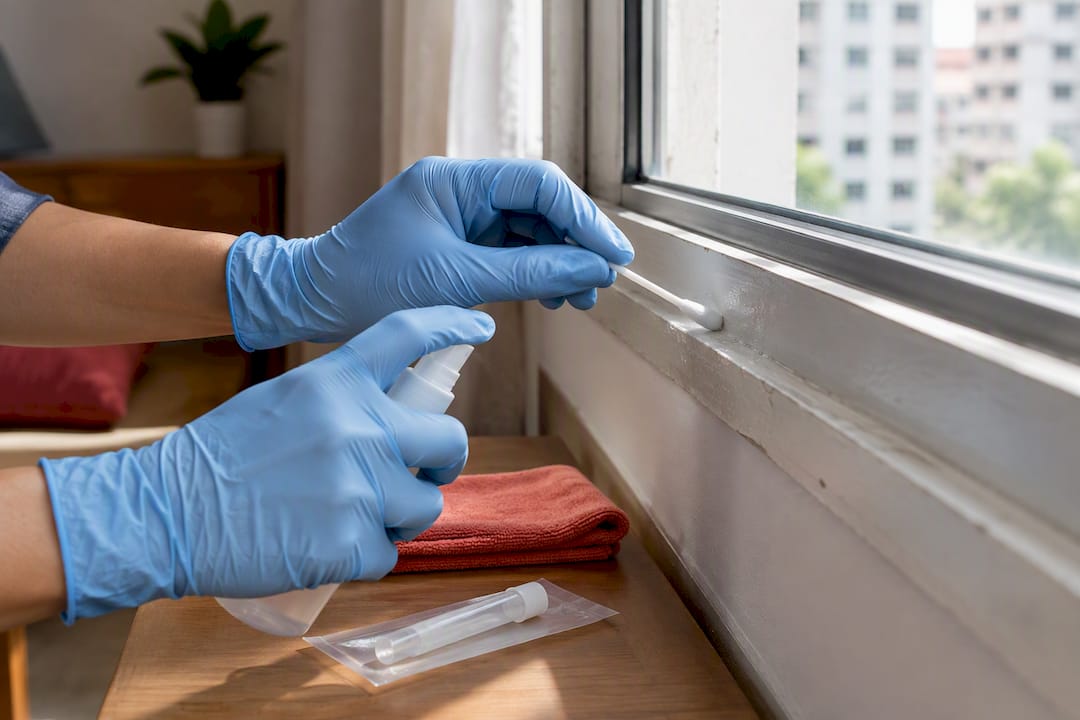
Test multiple layers if you can access them. Paint applied in different decades often sits in visible strata at door frames or window edges, and older, deeper layers are more likely to carry higher lead content than the top coat.
Bag every sample and swab in a sealed plastic bag immediately, and wipe down your tools and the surrounding surface with a damp cloth before you leave the room. Wash your hands thoroughly afterward, even if you wore gloves.
If a swab kit shows a positive reaction, or if you’re planning any structural work, escalate to XRF screening or lab testing rather than relying on the swab result alone. It tells you lead is present; it doesn’t tell you how much, and that number matters for deciding between encapsulation and full removal.
How Do You Dispose of Lead Paint Waste in Singapore?
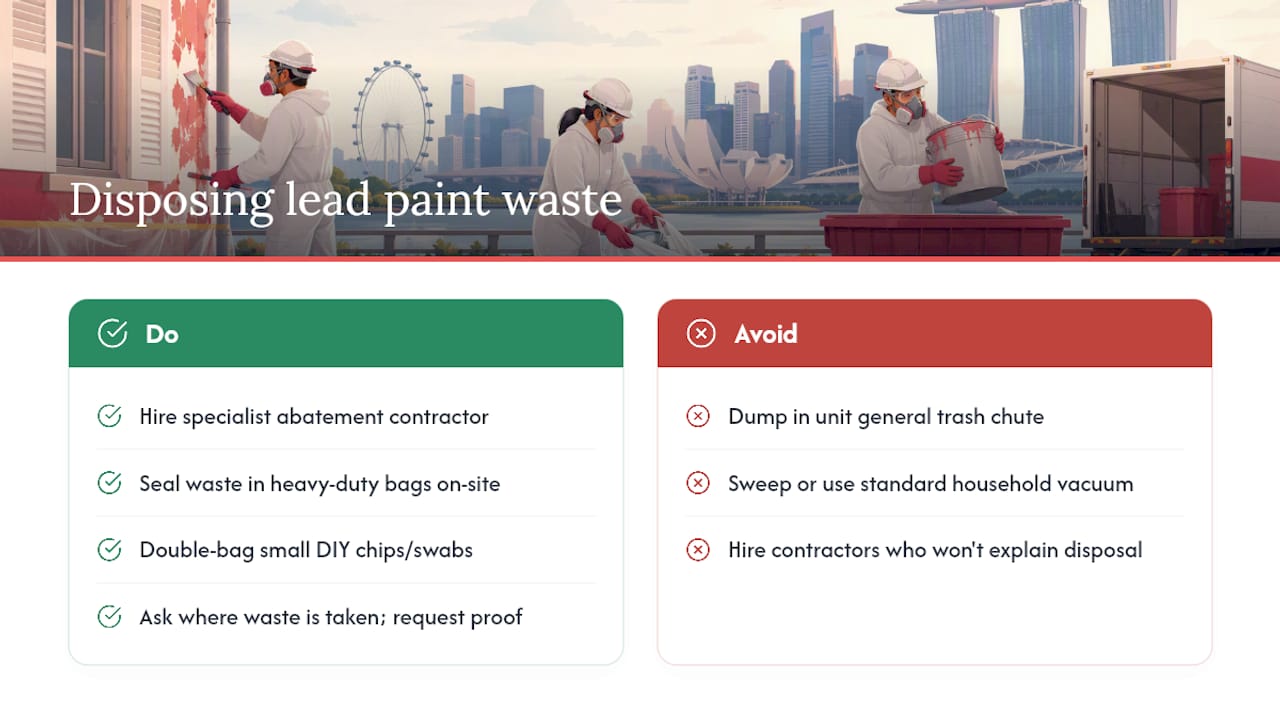
Lead paint waste, including scraped chips, contaminated sanding dust, and used containment sheeting, falls under Singapore’s broader hazardous waste handling expectations rather than regular household refuse. Dumping it in your unit’s general trash chute risks spreading contaminated dust through the disposal process itself.
Specialist abatement contractors typically handle this as part of their service, sealing waste in heavy-duty bags on-site before it leaves the property. This is one of the reasons hiring a contractor experienced in hazardous material removal matters. It isn’t just about the paint coming off the wall safely; it’s about what happens to it afterward.
If you’ve done limited DIY sampling rather than full abatement, double-bag small quantities of paint chips or swabs in sealed plastic before disposal, and avoid sweeping or vacuuming with a standard household vacuum, which can re-release fine particles into your home’s air. For any renovation-scale job producing significant paint waste, ask your contractor directly how and where the waste is being taken, and request documentation. A contractor unwilling to explain their disposal chain is a sign to look elsewhere.
A Practical Action Plan for Homeowners
Test first, avoid disturbing anything in the meantime, then decide between encapsulation and full removal once you know the concentration. If the area will stay undisturbed and the paint is intact, containment plus a competent repaint can be reasonable. If you’re renovating or the paint is failing, bring in a specialist and insist on clearance verification before anyone repaints over it.
As a brand signal worth noting: firms like 5starpainting illustrate what a careful, all-inclusive contractor model looks like locally, pairing surface preparation with a dedicated project manager on each job. That kind of structured process is what you should be comparing other quotes against. Get at least two or three quotes, and never skip the safety questions just because a price looks attractive.
— Fabian
Where to Verify Singapore’s Lead Paint Rules
Check the official NEA circular on enhanced lead-in-paint controls for the exact 90 ppm rule text, the NEA hazardous substances page for broader policy context, and the REACH public consultation record for how the rule was developed.
Once you’ve dealt with testing or mitigation, planning the actual repaint is worth doing right. A guide on surface preparation before painting walks through what proper prep looks like, and if you’re budgeting the job, typical Singapore painting costs give you a reference point. Families renovating with young kids at home may also find this guide on child-friendly renovation planning useful for sequencing work safely.
When you’re ready to repaint after testing or mitigation, 5starpainting’s HDB painting packages and condo painting packages come with all-inclusive pricing, genuine Nippon Paint, and a dedicated project manager overseeing prep and cleanup on every job.
This article is general information, not a substitute for advice from a qualified doctor. Consult a qualified healthcare professional about your own circumstances before acting on anything here.
FAQ
How Can I Tell if Paint in My Home Is Lead-Based?
Start with a DIY swab test kit for a quick screen, but confirm with portable XRF screening or a lab sample if you get a positive result or plan renovation work. Homes painted before the 1980s carry the highest likelihood of legacy lead paint in Singapore.
Is Lead Paint Still Dangerous if It’s Been Painted Over?
Yes, if the covered layer eventually chips, peels, or gets disturbed during renovation. Intact, undisturbed paint is lower risk, but sanding or drilling through a newer coat releases dust from whatever lies underneath it.
Is It Safe to Live in a House With Lead Paint?
Living with intact, undamaged lead paint carries low immediate risk since the danger comes mainly from disturbed paint dust rather than the paint sitting still on a wall. The bigger concern is peeling or flaking paint, or any upcoming renovation work that will disturb those surfaces.
Can I Still Buy Paint With Lead in It in Singapore?
No. Since 3 January 2022, NEA rules prohibit manufacturing, importing, or selling paint exceeding 90 ppm total lead for local use, aside from specific industrial exemptions like anti-corrosion and anti-fouling coatings. This applies to new paint sold today, not to legacy paint already on older walls.