
A painting contract worth signing names both parties and the property, spells out a room-by-room scope with paint brand and sheen, sets a deposit/progress/final payment schedule, and locks in a written change-order process. It also covers workmanship warranty length, proof of insurance, realistic start and completion dates, and a final inspection step before the last payment clears. Miss any of these, and you’re negotiating from a weaker position once the brushes are already out.
TL;DR:
- A comprehensive painting contract should specify the room-by-room scope, including surfaces, coats, sheen, and approved mock-up photographs to prevent disputes.
- Payment terms must follow a three-stage process: deposit, progress payment after preparation and partial work, and final payment only after inspection and approval.
- Surface preparation tasks like cleaning, sanding, filling, and priming require clear, measurable language to avoid callbacks caused by underscoped work.
- Naming the exact paint brand, product code, and sheen is essential for quality assurance, with written owner approval required for any substitutions.
- Weather-related delays and warranty terms should be clearly outlined, with provisions for delays due to monsoon rains and a written process for defect claims within the warranty period.
Table of Contents
- What Are the Key Painting Contract Terms to Include?
- How Should Payment Terms and Change Orders Work?
- What Prep Work and Exclusions Should the Contract Spell Out?
- Why Naming the Paint Brand and Sheen Matters
- Setting Realistic Timelines Around Singapore’s Weather
- What Warranty Terms Protect Your Investment?
- Insurance and Licensing Checks Before You Sign
- How Is Final Acceptance and Handover Determined?
- Contract Checklist: Clauses to Confirm Before You Sign
- Sample Clause Wording You Can Adapt
- Author perspective: real-world benefits of a detailed contract
- Get a Contract-Ready Quote for Your Property
- Primary Sources and Templates to Review
- Sources
- FAQ
What Are the Key Painting Contract Terms to Include?
The strongest painting service agreement reads less like a quote and more like a blueprint, every surface, every coat, every dollar tied to a milestone.
Building a room-by-room finish schedule
A vague line like “paint interior walls” invites disputes the moment the job is halfway done. A proper finish schedule breaks the work down by room, listing the surface (wall, ceiling, door frame, grille), the number of coats, and the sheen (matte, eggshell, satin). A comprehensive painting scope of work also specifies application method and, for surfaces where it matters, minimum film thickness, so both sides know exactly what “done” looks like.
For HDB flats, this usually means listing each bedroom, the living and dining area, and the kitchen separately, since sheen often changes between wet and dry zones. Condo and landed jobs add exterior walls, balconies, and gates, where UV exposure changes the paint system entirely.
- Room name and surface type (drywall, plaster, metal grille, wood trim)
- Coat count per surface (two coats is standard for most residential walls)
- Sheen level matched to the room’s function
- Mock-up panel location and who signs off on it before full application begins
- Maintenance tins labeled with product name and area applied, handed over at completion
Pro Tip: Ask the contractor to photograph the approved mock-up panel and attach it to the signed contract. If a color dispute comes up later, that photo becomes your reference point, not memory or opinion.
Keeping a labeled tin on hand for touch-ups years later matters more than most owners realize. Without the exact product code, a repaint job can leave a visible patch that never quite matches.
How Should Payment Terms and Change Orders Work?
Payment structure is where most contract disputes start, and it’s also the easiest part to get right on paper.
- Deposit at signing — typically a modest percentage to secure your slot and materials.
- Progress payment — released after surface preparation and roughly half the painting is complete, giving you a checkpoint to inspect work quality before more money changes hands.
- Final payment — due only after you’ve walked through the property and confirmed the finish matches the agreed scope. This three-stage structure is the standard used across professional painting contracts, and it protects you far better than a 50/50 split with no inspection step.
Change orders deserve their own clause, not a verbal handshake. If the contractor finds rotten wood behind a window frame or the owner decides to add a feature wall mid-job, the added cost and time should be documented in writing, priced before work starts, and signed by both parties. Verbal add-ons are the single biggest cause of a final invoice that doesn’t match expectations.
If the finished work falls short, you’re entitled to withhold the final payment portion until defects are corrected. That leverage disappears the moment you pay in full.
What Prep Work and Exclusions Should the Contract Spell Out?
Underscoped surface preparation causes more callback complaints than any other single issue. A prep clause with vague wording (“prepare surfaces as needed”) gives a contractor room to skip steps that matter.
Specify these tasks with measurable language:
- Washing surfaces to remove grease, mold, and dust before sanding
- Sanding glossy or previously painted surfaces to promote adhesion
- Filling nail holes and hairline cracks up to a stated size (for example, up to 3mm) with appropriate filler
- Caulking gaps around trim, windows, and door frames
- Priming bare or repaired patches before topcoat application
A breakdown of common contractor omissions shows that skipped substrate prep is the root cause behind peeling and blistering complaints filed months after handover, not the paint brand itself.
Equally important is what’s excluded. Wallpaper removal, structural timber repair, and major plaster skimming are commonly outside a standard painting quote. If your walls turn out to need more than surface patching once the old coat comes off, the contract should require the contractor to document the issue with photos, quote the additional work separately, and get your written approval before touching it.
Why Naming the Paint Brand and Sheen Matters
A contract that just says “quality paint” leaves the door open for substitution with a cheaper product after you’ve signed. Insist on the brand, product code, and sheen for every surface, along with primer compatibility for that substrate. Naming a paint product also justifies price differences: premium low-VOC lines cost more than budget interior paint, and you deserve to know which one you’re paying for.
- State the exact product line and code per area (not just “premium interior paint”)
- Require written owner approval before any substitution, backed by a side-by-side product datasheet comparison
- Ask for low-VOC or odorless formulations if the unit will be occupied during painting, and clarify who handles ventilation
- Confirm maintenance tins are labeled and handed over at project close for future touch-ups
Setting Realistic Timelines Around Singapore’s Weather
Singapore’s climate adds a wrinkle most mainland contract templates never mention. State the start date, estimated working days, and a completion target clearly. Then add a clause allowing reasonable delay for heavy monsoon rain (which affects exterior work and drying times) and for MCST-controlled building access, such as lift booking windows or restricted working hours in condos.
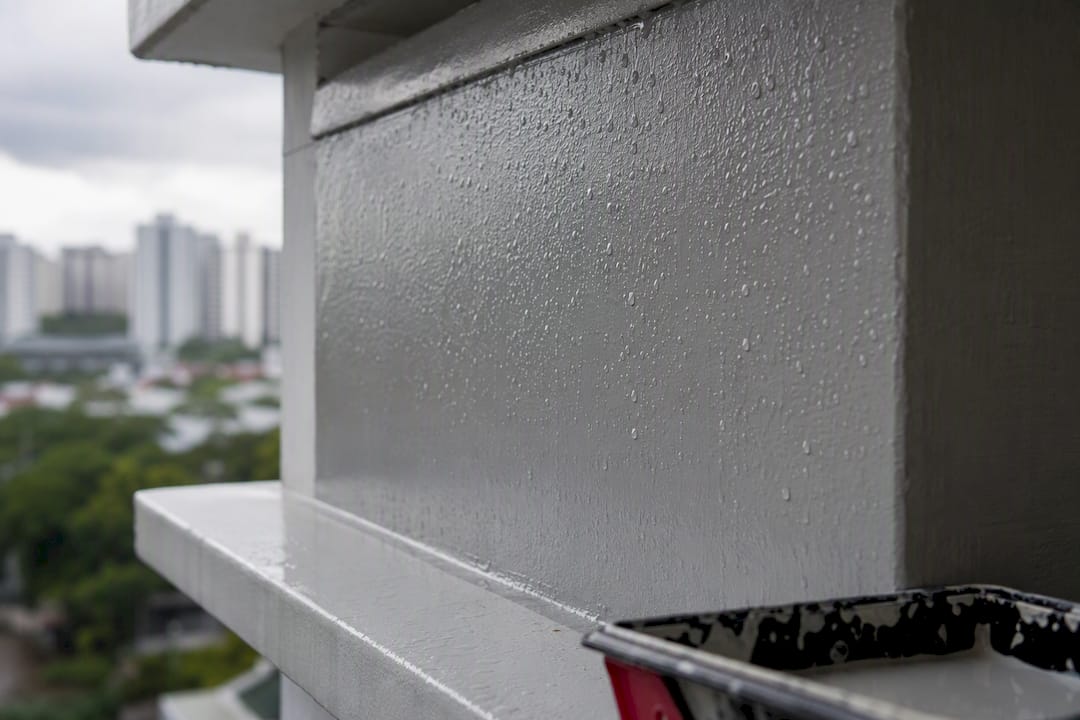
The contract should require written notice within a short window (24 to 48 hours) whenever a delay occurs, rather than leaving you to guess why the crew didn’t show up. If completion slips well past the agreed date without a valid delay reason, the remedy doesn’t need to be a punitive penalty clause. A simple provision letting you withhold a portion of payment until completion, or negotiate a modest discount for unreasonable delay, usually resolves this without turning into a legal fight.
What Warranty Terms Protect Your Investment?
A workmanship warranty covers peeling, bubbling, or uneven coverage caused by application error, separate from any manufacturer warranty on the paint itself. Interior warranties commonly run around one year; exterior warranties, given Singapore’s sun and rain exposure, sometimes carry shorter or conditional terms depending on the paint system used.
- Confirm the warranty period in writing, along with what triggers a valid claim
- Understand that material defects (a faulty paint batch) may fall under the manufacturer’s warranty rather than the contractor’s
- Keep your side of the bargain: avoid drilling or hanging heavy fixtures into freshly painted walls before the cure period ends, since damage from that voids most workmanship claims
- Know the notification process: report the issue, allow a scheduled inspection, then a repair window
Pro Tip: Photograph problem areas the day you spot them, with a timestamp. Contractors move faster on warranty claims when the evidence is already documented.
Insurance and Licensing Checks Before You Sign
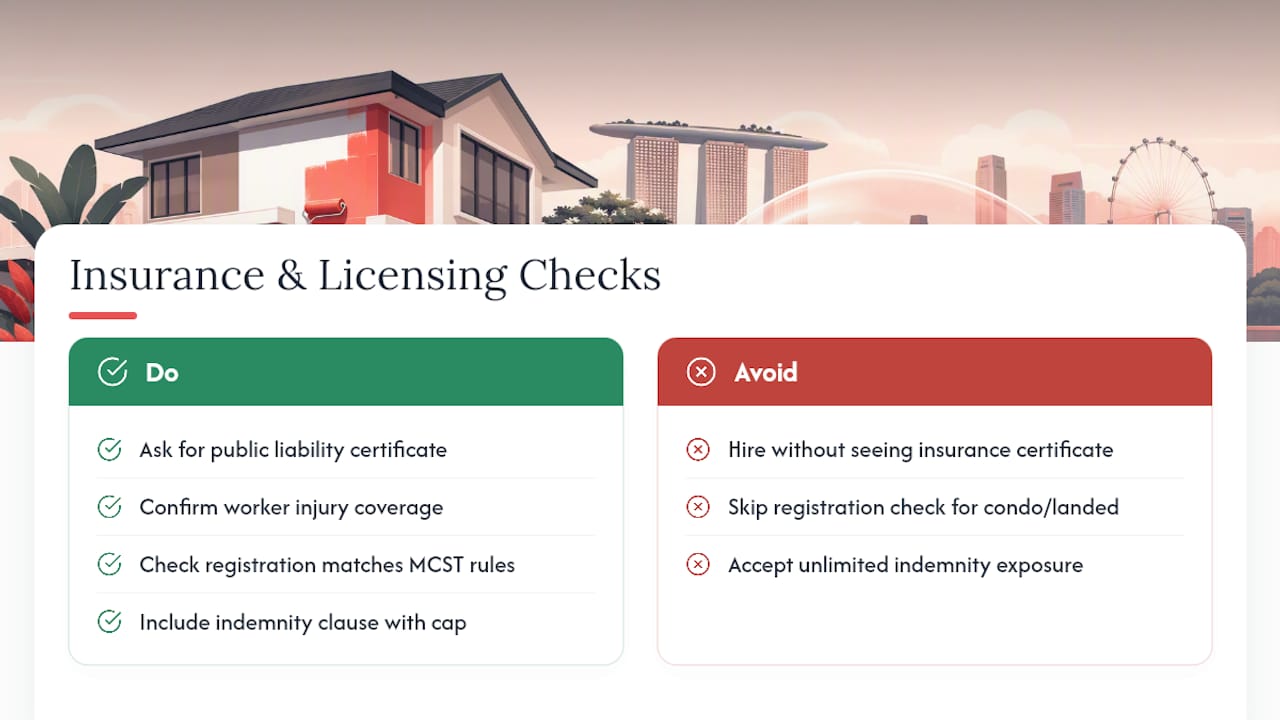
Ask for proof of public liability insurance and, where the contractor employs a crew, confirmation of worker injury coverage. A legitimate operator provides a certificate of insurance without hesitation. For condo and landed projects, also confirm the contractor’s registration details align with what your MCST or property management office requires for access approval. An indemnity clause with a reasonable cap protects you if property damage occurs during the job, without exposing the contractor to unlimited liability for unrelated issues.
How Is Final Acceptance and Handover Determined?
Final sign-off should follow a defined sequence, not a quick walkthrough while the crew is packing up.
- Compare finished surfaces against the approved mock-up panel and the written finish schedule.
- Walk the property together and note any deficiencies on a shared list.
- Confirm the number of included touch-up visits (commonly one to two) before extra visits carry an added cost.
- Withhold the final payment portion until every item on the deficiency list is resolved.
This structure protects both sides: the contractor gets paid promptly once the work is genuinely complete, and you’re not left chasing touch-ups after the check has cleared.
Contract Checklist: Clauses to Confirm Before You Sign
Run through this list before you put your signature on anything.
- Both parties and the exact property address are named correctly
- Full room-by-room scope, including surfaces, coat counts, and sheen
- Paint brand, product code, and sheen specified per area
- Payment schedule tied to deposit, progress, and final inspection
- Written change-order process with pricing agreed before work starts
- Warranty length and what it covers stated in writing
- Proof of insurance provided, not just promised verbally
- Mock-up panel requirement and approval authority named
- Maintenance tins included at handover, labeled with product details
- Final inspection method and deficiency-list process defined
A standard contract template built around these categories, named parties, service description, payment schedule, warranty, insurance, and change-order process, gives you a working structure to compare any quote against. Underspecified scope is consistently the root cause behind the painting disputes that escalate into formal complaints, because “paint the living room” simply doesn’t tell anyone what was promised.
Sample Clause Wording You Can Adapt
A few short templates to start from:
- Scope: “Contractor shall apply two coats of [product, code, sheen] to all drywall surfaces in [room], per the approved mock-up dated [date].”
- Payment: “Owner shall pay a reasonable deposit on signing, a progress payment on completion of preparation and first coat, and a final payment after inspection approval.”
- Change order: “Any variation to scope shall be documented in writing, priced, and signed by both parties before work proceeds.”
- Warranty: “Contractor warrants workmanship for 12 months from completion date against peeling, blistering, or uneven coverage.”
These adapt easily: HDB units usually need fewer exterior clauses, condos add MCST access language, and landed properties require exterior weatherproofing specs. 5starpainting structures its own six-stage painting process around this same logic, pairing a written scope with a dedicated project manager for each job.
Author perspective: real-world benefits of a detailed contract
Most callback complaints trace back to one thing: prep work that was assumed rather than written down. When a contract just says “prepare surfaces,” someone eventually skips a step, and the peeling shows up months later. Insist on named products, an approved mock-up panel, and a written change-order process before you sign anything. It costs you five extra minutes at the table and saves weeks of arguing later.
— Fabian
Get a Contract-Ready Quote for Your Property
Some companies build every quote around the same clarity this article recommends: named products, room-by-room scope, and upfront pricing. Projects may include furniture protection, cleanup, and a workmanship warranty, with a project manager assigned from start to finish.

Whether you’re preparing an HDB flat for a resale deadline or repainting a condo unit, you can request a contract-ready quote that spells out scope, materials, and payment milestones before any brush touches a wall. Reach out for a written quote and compare it line by line against the checklist above.
Primary Sources and Templates to Review
- Painting scope of work (Provision) breaks down substrate-level specs and mock-up requirements in detail.
- Painting contract template (Rocket Lawyer) offers a downloadable structure covering warranty and insurance clauses.
- Painting contract template (ContractsCounsel) explains standard three-stage payment terms.
- Scope of work generator for painters lets you build a custom scope document to adapt for local conditions.
Sources
- Painting contract template (ContractsCounsel)
- Painting scope of work (Provision)
- Painting contract template (Rocket Lawyer)
FAQ
What should be included in a painting contract?
A solid painting contract names both parties and the property, details the room-by-room scope with paint brand and sheen, sets a payment schedule tied to milestones, and includes warranty, insurance, and change-order clauses.
What is the average salary for painters in Singapore?
Singapore painting providers typically quote fixed, all-inclusive project prices by property type (HDB, condo, or landed) rather than hourly wages, so your contract should focus on total price and inclusions rather than a per-hour rate.
What are normal payment terms for a contractor?
Most professional painting contracts use a three-stage structure: a deposit at signing, a progress payment once preparation and part of the painting is done, and a final payment after you’ve inspected and approved the finished work.
What are the five types of contracts?
Common contract types include fixed-price, cost-plus, time and materials, unit-price, and milestone-based agreements. Most Singapore residential painting jobs, including those from 5starpainting, use a fixed-price structure with milestone payments.
How many touch-up visits should a painting contract include?
Most contracts include one to two touch-up visits within a short window after final inspection, with additional visits priced separately if new issues arise beyond that period.