
Two finish coats over a properly prepared surface is the standard for almost every interior and exterior job. The one exception is a like-for-like touch-up, where you’re matching the exact same product and color on a clean, sound wall, and one coat will do. Primer changes the math, too: tint it toward your final color and you can often hold the job at two finish coats even on a dramatic color change.
TL;DR:
- Two finish coats are generally sufficient for repainting walls with similar colors, while three coats are needed for dramatic color changes unless tinted primer is used.
- Porous surfaces like bare drywall, wood, or masonry always require primer plus two coats, with skipping primer risking uneven results.
- Tinted primer, mixed 40 to 60 percent toward the final color, can reduce the number of coats from three to two in high-contrast or saturated color projects.
- Most interior water-based paints dry enough for recoating within 2 to 4 hours under normal conditions, but humidity and temperature can extend this window.
- An abrupt need for additional coats often results from insufficient surface preparation, such as skipping primer or patching, not the paint itself.
Table of Contents
- How Many Coats of Paint Do You Need for Common Projects?
- How Many Coats Does Each Surface Need?
- What Does Primer Actually Do, and When Should You Tint It?
- How Long Should You Wait Between Coats?
- How Do You Know If You Need Another Coat?
- How Much Paint Do You Need for Each Coat?
- What Do Professional Painters Do Differently?
- DIY Two Coats or Hire a Pro: How Do You Decide?
- Want the Coat Count Handled for You?
- Sources
- FAQ
How Many Coats of Paint Do You Need for Common Projects?
Most painting questions boil down to a handful of situations, and the right coat count follows a pattern once you know what to look for.
- Standard repaint, same or similar color: two coats. This gets you to the dry film thickness paint manufacturers engineer for even color and sheen, typically 4 to 5 mils.
- Quick touch-up, identical paint and color, clean wall: one coat. This only works when you’re patching a scuff or scratch with the exact same product, not refreshing a whole room.
- Bare drywall, raw wood, or masonry: primer plus two finish coats, three passes total. Skipping the primer step on porous material is the single most common cause of blotchy, uneven results.
- Dramatic color change, dark to light or a saturated pigment: three or more finish coats, unless you use tinted primer to cut that back down to two.
- Any surface with stains, water marks, or repairs: primer first, always, regardless of how many finish coats follow.
The pattern underneath all of this: coat count follows the dry film thickness a paint is engineered to deliver, not personal preference. One thin coat rarely gets you there. Three coats on a surface that only needed two just adds cost and dry time without adding durability. The goal is matching the coat count to the actual condition of the surface in front of you, not defaulting to whatever number sounds safe.
If you’re unsure which category your project falls into, the surface itself usually tells you. A wall that’s been painted the same color for years and just needs freshening is a different job than a wall going from navy to white.
How Many Coats Does Each Surface Need?
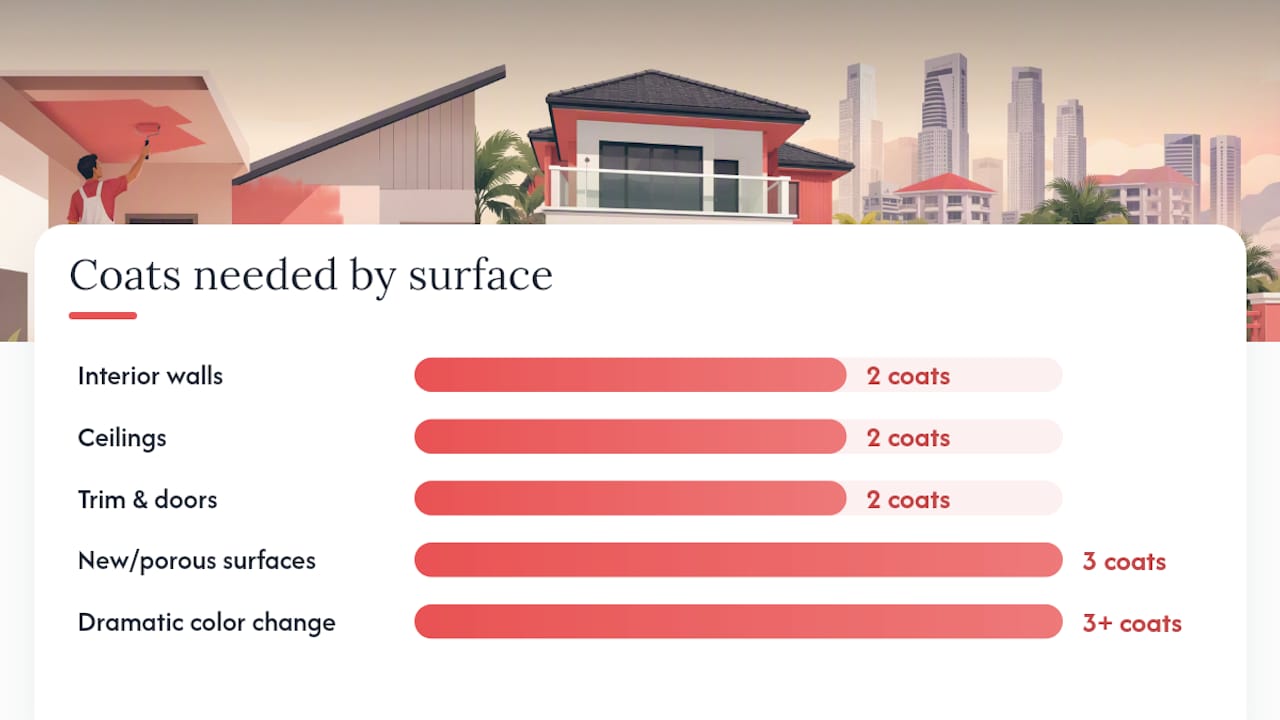
Coat count isn’t one-size-fits-all across a home. Walls, ceilings, trim, and exterior masonry each behave differently under a brush or roller, and each has its own logic for why two coats is the floor rather than the exception.
Interior walls. A standard repaint over existing paint in similar condition needs two finish coats. New drywall or a wall that’s been patched needs primer first, then two finish coats, three passes in total. Skipping primer on patched drywall is why you sometimes see a slightly duller or shinier patch peeking through months later.
Ceilings. Ceilings look simple but they’re deceptively hard to get even, because flat overhead light shows every roller mark and thin spot that wall-level lighting hides. Two coats, applied in consistent, overlapping passes, is standard here too.
Trim and doors. Trim gets more wear and more scrutiny than walls, since it sits at eye level and gets touched constantly. Two finish coats in a semi-gloss or satin sheen are the norm for durability and a smooth, wipeable surface.
New drywall, bare wood, and masonry. These are porous or unsealed, so primer isn’t optional. Expect primer plus two finish coats, three total passes, whether it’s a new HDB wall or an exterior masonry surface.
Dramatic color changes. Going from a deep saturated color to white, or the reverse, often demands three or more finish coats if you skip primer entirely, since low-hide pigments like deep reds and yellows need extra layers to fully cover what’s underneath.
A wallpaper-to-paint transition adds another wrinkle: textured surfaces left behind by old adhesive or backing paper often need an extra primer pass before the two finish coats will lay flat and even.
What Does Primer Actually Do, and When Should You Tint It?
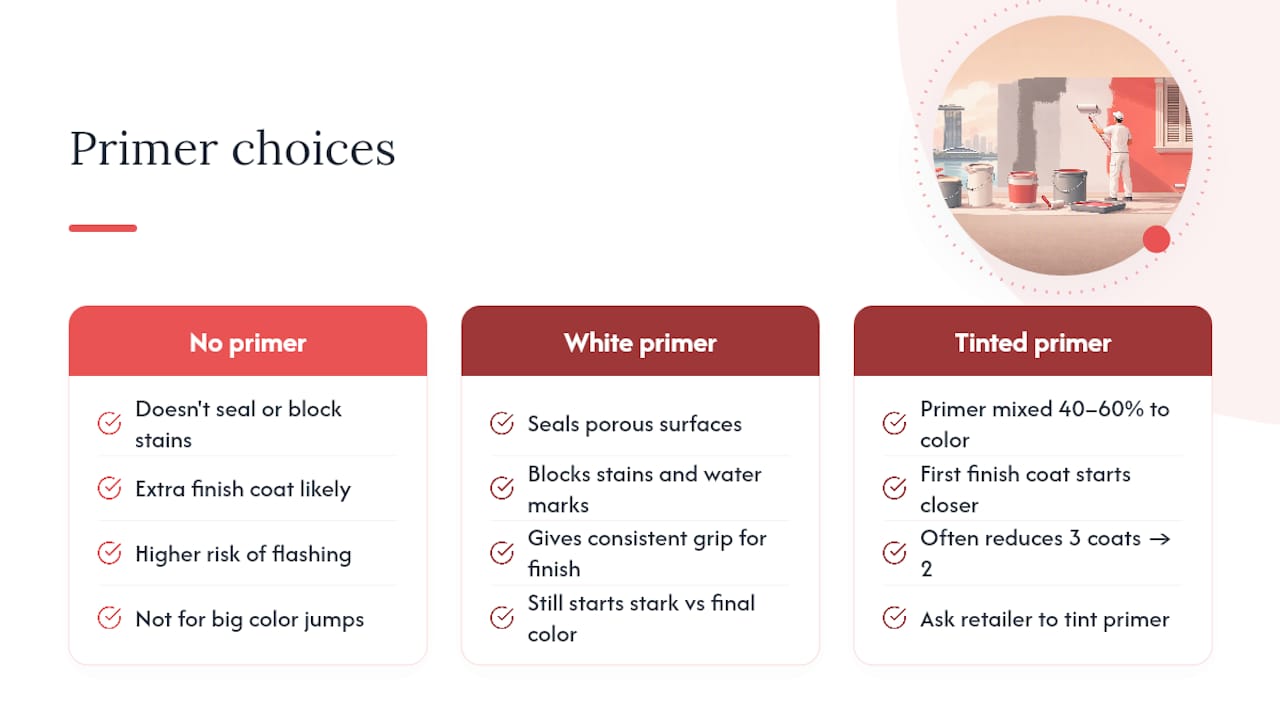
Primer isn’t a placeholder step before the “real” paint goes on. It seals porous material, blocks stains and water marks from bleeding through, and gives finish coats something consistent to grip. Skip it on a patched or porous wall and you’ll likely need an extra finish coat just to compensate, along with a higher risk of flashing, where patched spots dry a visibly different sheen than the rest of the wall.
Tinted primer is the professional shortcut for dramatic color changes. Rather than starting from stark white, painters mix primer roughly 40 to 60 percent toward the final color, so the first finish coat starts closer to its target instead of fighting through a starkly different base. That single adjustment is often the difference between needing three finish coats and needing two.
Pro Tip: Ask your paint retailer to tint the primer itself, not just the top coat, when you’re making a big color jump. Most stores can do this on the spot, and it costs little more than a standard white primer.
Do you need primer before painting every project? Not always. A like-for-like touch-up on a clean, unpatched wall generally doesn’t need it. But any surface that’s bare, patched, stained, or shifting to a very different color benefits from it, and skipping that step is the fastest way to end up back at the store buying a third can of paint.
How Long Should You Wait Between Coats?
Drying time depends on the product, and the label on your can is the most reliable source, but general patterns hold across most water-based interior paints.
- Water-based paints typically allow recoating after about 2 to 4 hours under normal indoor conditions.
- Solvent-based (oil-based) products generally need longer recoat windows, sometimes overnight, so check the can before scheduling a same-day second coat.
- Humidity and cool temperatures slow drying noticeably; running a fan or air conditioner speeds it back up.
- Two coats in a single day is realistic for most rooms with water-based paint and decent airflow; three coats in a day is tight but doable if the first two dry fast and you’re not battling humidity.
Is two hours enough between coats? For many water-based products, yes, but that’s a minimum under ideal conditions, not a guarantee. A muggy day or a poorly ventilated room can stretch that window considerably. Judge readiness by touch and appearance, not just the clock.
How Do You Know If You Need Another Coat?
Wait until the coat is fully dry before judging it. Wet paint almost always looks more even and more saturated than it will once it cures, and that gap is what leads people to stop one coat too early.
- Check for patchiness or bleed-through once dry. If the old color or a patched spot is still visible, you need another coat.
- Look for uneven sheen, sometimes called flashing, where some areas look flatter or glossier than others under the same light.
- Scan for roller marks or lap lines left by uneven overlap, especially near corners and edges.
- Check from multiple angles under both natural daylight and artificial light, since a wall that looks fine from the doorway can show streaks from a different angle.
If any of these show up after the paint is fully dry, uneven coverage is fixable with one more coat applied the same way as the last, not by going back over just the patchy spot.
How Much Paint Do You Need for Each Coat?
Manufacturer coverage is usually listed as square feet per gallon, commonly 350 to 400 square feet per gallon per coat on smooth, sealed walls. The formula is simple: divide your wall area by the coverage per gallon, then multiply by the number of coats you’re applying.
Here’s how that plays out for a typical 400 square foot room:
| Coats | Gallons needed (approx.) | Relative material cost |
|---|---|---|
| 1 coat | 1 gallon | Baseline |
| 2 coats | 2 gallons | Double |
| 3 coats | 3 gallons | Triple |
That third row is exactly why tinted primer matters on big color changes. If tinting the primer lets you hold the job at two finish coats instead of three, you’re saving a full gallon’s worth of paint and labor on an average room, and a proportionally larger amount across a whole flat. For a full breakdown of calculating paint for a room, match your actual wall area against your chosen paint’s coverage label before you buy.
What Do Professional Painters Do Differently?
Professional painting jobs generally follow a consistent sequence: thorough surface prep, patching and sanding, primer where the surface calls for it, two finish coats, protection for furniture and floors, cleanup, and a warranty on the finished work. This sequence is structured around this kind of process, with a dedicated project manager assigned to track prep quality and confirm each coat meets spec before the next one goes on.
That level of oversight matters because most “why do I need a third coat” problems trace back to weak prep, not the paint itself. You can mirror the same logic at home:
- Wash walls before painting to remove grease and dust that block adhesion.
- Patch and sand rough spots so primer and paint sit evenly.
- Choose primer deliberately, tinted if you’re making a big color jump, rather than skipping it to save time.
Good prep is what keeps a two-coat job a two-coat job.
DIY Two Coats or Hire a Pro: How Do You Decide?
A DIY two-coat job makes sense when you’re repainting a similar color on walls in reasonable condition and you have a free weekend. It stops making sense the moment the job involves a dramatic color change, porous or damaged surfaces, or a flat you’re prepping for resale, where an uneven finish can cost you more at sale time than a contractor would have charged upfront.
Ask yourself three questions: Is this a color change or a like-for-like refresh? Is the surface porous, patched, or previously unpainted? Does the outcome need to look flawless for a buyer or tenant, not just acceptable to you? Two or more “yes” answers usually tip the scale toward hiring out.
— Fabian
Want the Coat Count Handled for You?
If you’d rather not guess at recoat windows or run to the store for a third gallon, Some professional painting services build the right coat count into every quote before a brush touches your wall. Pricing is often all-inclusive, covering labor, genuine paint, furniture protection, and cleanup, with no hidden fees added once the job starts.

Often every job includes a dedicated project manager who oversees surface prep, primer decisions, and coat application from start to finish, sometimes backed by a warranty on the finished work. That matters most on the jobs where DIY coat counts go wrong: dramatic color changes, porous or previously unpainted surfaces, and flats being prepped for resale where the finish has to hold up to scrutiny. HDB owners can review the HDB painting packages for a project scoped and quoted before work begins, while condo owners can check the condo painting packages for the same all-inclusive approach. Request a quote through either page to get a coat count and price locked in before your next paint job starts.
Sources
These are the standards and manufacturer resources behind the coat counts in this guide:
- Singapore Standard (film thickness guidance)
- Nippon Paint — How to paint a room (coverage and coat suggestions)
- How Many Coats of Paint Do I Need? — PaintPricing
Always check your specific paint can’s label for exact coverage and recoat figures, since formulas vary by brand and finish.
FAQ
Is 3 Coats of Paint Too Much?
Not if the surface calls for it. Three coats is appropriate for dramatic color changes, low-hide pigments, or bare porous surfaces like new drywall, but it’s excessive for a standard same-color repaint, where two coats already reaches the manufacturer-specified film thickness.
Should You Do 1 or 2 Coats of Paint?
Two coats is the standard for nearly every repaint or new-color project. One coat only works for a like-for-like touch-up using the exact same product and color on a clean, sound wall.
Is 2 Hours Enough Between Coats of Paint?
For many water-based paints under good indoor conditions, about 2 to 4 hours is enough, but humidity and cool temperatures can stretch that window. Always check the specific paint can’s label rather than assuming a fixed time.
How Many Coats of Paint Can You Do in a Day?
Two coats in a single day is realistic for most rooms using water-based paint with decent airflow. Three coats in one day is possible only if each coat dries fast and conditions stay favorable, which is one reason professional crews often schedule larger color changes over two days.
Does 5starpainting Include Primer and Multiple Coats in Its Pricing?
Yes. 5starpainting’s HDB packages and condo packages are all-inclusive, covering the labor, genuine Nippon Paint, and coats needed to complete the job correctly, with primer and sealer available as a separate line item starting at $250 per whole flat.