
Paint coverage per square metre typically runs 10 to 14 m² per liter for smooth, previously painted interior walls. The formula you need is: liters = (area ÷ coverage rate) × number of coats. Measure your wall area, check the coverage rate on the product’s Technical Data Sheet, multiply by your coat count, then add roughly 10% for waste. That single calculation prevents both a mid-job paint run and a garage shelf full of leftover tins.
TL;DR:
- The actual coverage rate can vary between 10 and 14 m² per liter for interior walls, depending on surface condition and application method.
- Accurate calculations require measuring perimeter, subtracting openings, and using the technical data sheet’s coverage rate to avoid excess or shortages.
- Porous, textured, or uneven surfaces can increase paint consumption by up to 40%, so adjusting estimates based on surface condition is essential.
- Professionals adjust their estimates based on real-time consumption and surface preparation, often saving paint and reducing waste.
- Choosing larger paint tins and adding a 10-15% contingency helps minimize waste and makes buying more economical.
Table of Contents
- How Do You Calculate Paint Needed for a Room?
- What Is the Typical Paint Coverage per Square Metre?
- Why Does Surface Condition Change How Much Paint You Need?
- Worked Examples: Interior Room and Exterior Wall
- How Do You Convert Liters Into Tins to Buy?
- What Do Singapore Painting Professionals Do Differently?
- When Should You Hire a Professional Painter Instead?
- Where Can You Find Reliable Paint Coverage Data?
- Sources
How Do You Calculate Paint Needed for a Room?
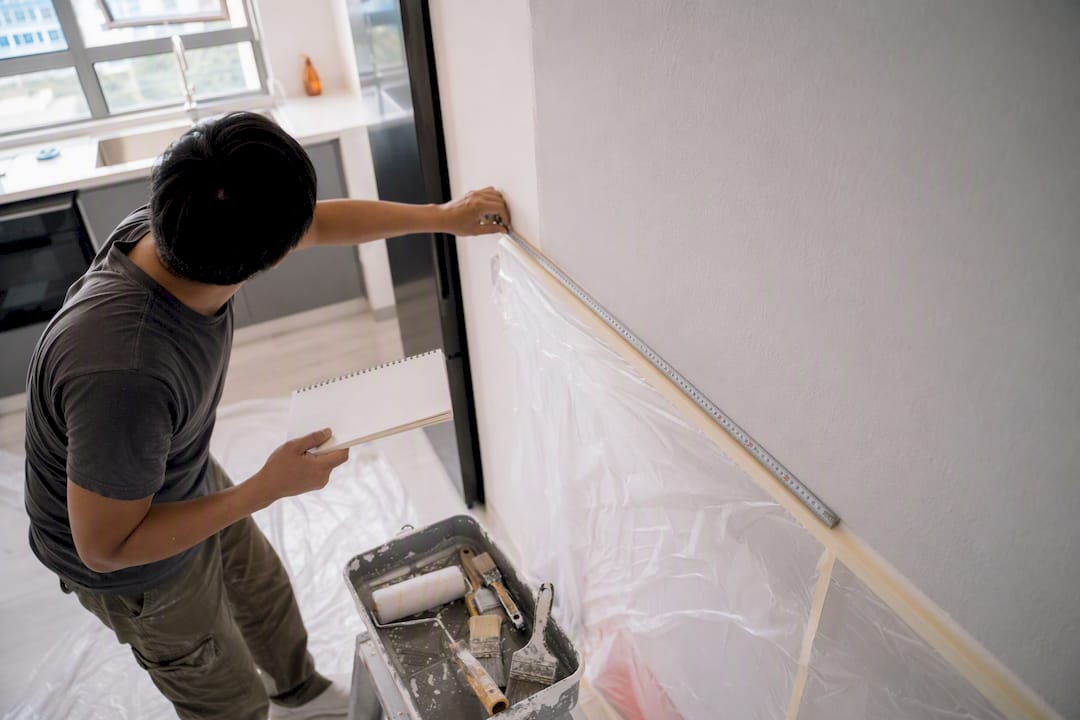
Getting an accurate liter count starts with a tape measure, not a guess. Skip the can label’s marketing claims and work from the actual dimensions of your space.
- Measure perimeter and height. Walk the room with a tape measure and record the length of each wall, then the ceiling height.
- Calculate gross wall area. Multiply total perimeter by height to get your starting square metre figure.
- Subtract doors and windows. A standard door removes about 1.6 to 1.8 m², and an average window removes 1.5 to 2.5 m², depending on size.
- Pull the spreading rate from the TDS. Every reputable manufacturer lists a “theoretical coverage” figure on the Technical Data Sheet, not the front label.
- Multiply by coats, then round up. Two coats doubles your liter requirement; round the final number up to the nearest tin size before you buy.
This sequence keeps you from overestimating a wall that is mostly window, or underestimating a room with four solid walls and no natural light.
What Is the Typical Paint Coverage per Square Metre?
Coverage rates swing hard depending on what you are painting and what condition the surface is in. Trade guidance groups most residential jobs into a handful of categories, and knowing which one your wall falls into matters more than any number printed on the tin.
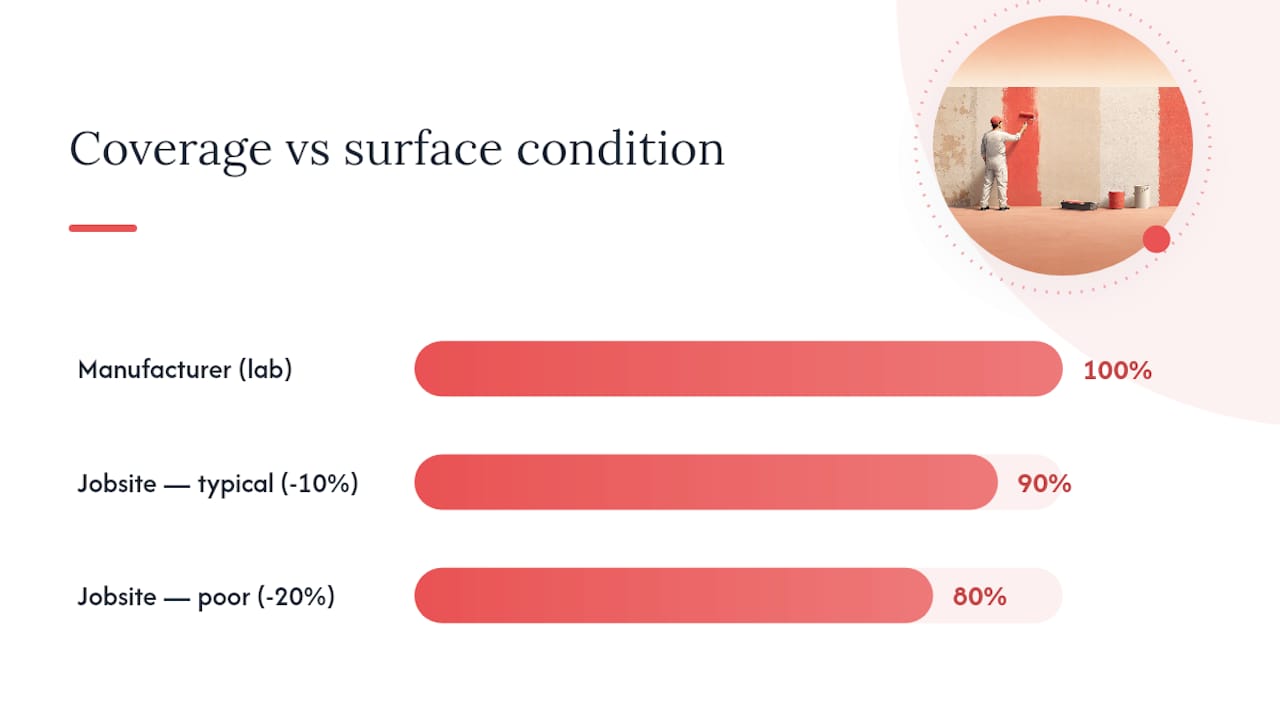
These figures come from manufacturer and trade coverage data, and they describe lab conditions more than your living room. Real jobsites lose 10% to 20% of that theoretical rate to uneven plaster, dust, temperature, and the simple fact that nobody rolls paint on as evenly as a testing rig does. Treat the manufacturer’s number as a ceiling, not a target.
Pro Tip: Never assume one coverage rate applies to your whole project. Calculate walls, ceilings, trim, and woodwork separately, since each surface soaks up paint at a different rate, then add the liters together.
Why Does Surface Condition Change How Much Paint You Need?
Two walls of identical size can need very different amounts of paint, and the difference almost always comes down to texture, porosity, and how you apply it.
- Porosity drives absorption. New plaster or bare masonry can push consumption up by 20% to 40% because the surface drinks paint before it has a chance to form a film.
- Texture eats extra paint. Rough render, popcorn ceilings, and textured wallpaper all demand more product than a flat, sanded surface.
- Roller nap matters. A thick nap roller holds more paint and lays down a heavier coat than a short nap or a fine foam roller.
- Brush versus roller versus spray. Brushing tends to use more paint than rolling for the same area, while spray application varies widely based on overspray and gun setup.
- Color change affects coat count. Going from a dark accent wall to white, or vice versa, often forces a third coat regardless of what the coverage rate suggests.
- Primer earns its keep. A dedicated primer seals porous surfaces and can cut topcoat consumption on the following coats.
Worked Examples: Interior Room and Exterior Wall
Numbers on a page mean little until you run them against a real space. Here are two calculations you can copy directly, one for a typical bedroom and one for a rougher exterior wall.
Interior bedroom, 3m x 4m, two coats:
- Perimeter is 14m, ceiling height is 2.5m, giving a gross wall area of 35 m².
- Subtract one door (1.8 m²) and one window (2 m²), leaving 31.2 m² of paintable wall.
- Using a mid-range coverage rate of 13 m²/L: 31.2 ÷ 13 × 2 coats = 4.8 liters.
- Round up to a 5L tin, which also covers a small touch-up reserve.
Exterior rough masonry wall, 20 m², primer plus two coats:
- Primer coat at 8 m²/L: 20 ÷ 8 = 2.5 liters.
- Topcoats at a reduced porous rate of 8 m²/L for two coats: 20 ÷ 8 × 2 = 5 liters.
- Total liters needed: 7.5 liters, rounded up to an 8L or 10L combination.
Both examples follow the same core formula: area divided by coverage rate, multiplied by coats. The worked example from Resene uses the identical structure, arriving at 7.6 liters for a 42 m² wall at 11 m²/L across two coats, then rounding up to an 8L tin for touch-ups. For more room-specific numbers, our guide on how much paint you need for a house breaks down several common room sizes.
How Do You Convert Liters Into Tins to Buy?
Once you have a liter figure, the next decision is which tin sizes actually get you there without waste or a second trip to the store.
- **Common sizes run 1L, 2.5L, 4 to 5L, and 10L. A 5L tin usually covers a moderate wall area across two coats on smooth surfaces.
- Add 10% to 15% contingency before rounding up, since most calculators recommend this buffer to cover spills, rework, and future touch-ups.
- Buy fewer, larger tins where the math allows it. A single 10L tin usually costs less per liter than four separate 2.5L tins.
- Stick to one batch number, or mix tins together. Retailers tint each batch slightly differently, so pouring multiple tins into one larger container before you start avoids a visible seam of mismatched color partway up the wall.
What Do Singapore Painting Professionals Do Differently?
Professional crews rarely trust the tin label alone; experienced painting contractors understand how paint formulation, wall condition, and surface texture affect coverage rates. They pull the coverage rate from the TDS, then track how much paint each wall actually consumes while the job is underway, adjusting the next wall’s estimate on the spot rather than after the fact.
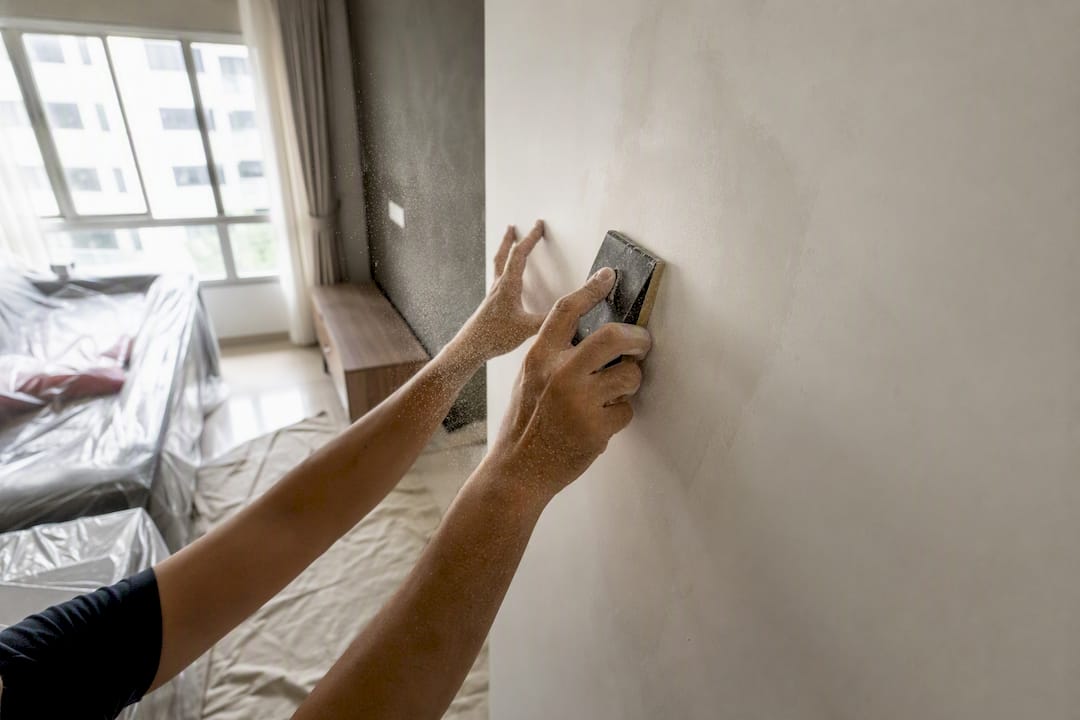
Surface preparation cuts waste more than any calculation does. A wall that is properly filled, sanded, and sealed absorbs paint evenly, which means the theoretical coverage rate actually holds up. Skip that prep and you will burn through 20% more paint compensating for patchy absorption, chasing a finish that still looks uneven. Measuring twice and prepping properly beats any spreadsheet.
— Fabian
When Should You Hire a Professional Painter Instead?
Running these calculations is worth it for a single feature wall or a weekend project. It gets a lot less appealing when you are staring down an entire HDB flat, a condo unit before resale, or exterior masonry that eats paint faster than any formula predicts. If your timeline is tight, your walls have tricky surfaces, or you simply want a warranty behind the finish, hiring a pro solves the coverage math for you entirely.
5starpainting quotes each job with all-inclusive fixed pricing that already accounts for surface prep, genuine Nippon Paint, furniture protection, and full cleanup, so there is no separate liter-by-liter guesswork or hidden top-up cost partway through. Every project gets a personal project manager tracking material use and finish quality from the first hole patch to the final coat. If you are weighing DIY against a guaranteed result, check the HDB painting packages starting from $600, or look at the condo painting services if you are preparing a unit for resale. Get a quote through the 5starpainting website and skip the tin math altogether.
Where Can You Find Reliable Paint Coverage Data?
Always confirm coverage against the specific product’s TDS before buying. Useful references include the Resene paint calculator, the SiteCalc coverage tool, and guidance on paint types for houses for surface-specific coverage differences.
One Response