
Small, recent chips on a low-visibility panel usually just need a touch-up. Widespread fading, peeling, or damage spread across several panels calls for a full repaint. The right call depends on three things: how big the damage is, how old and faded the paint is, and whether the finish is glossy enough to expose a mismatch. Touch-ups take an hour or two and cost far less; repaints take days and cost more, but they last.
TL;DR:
- Touch-ups are suitable only for small, recent damages on undamaged, unfaded paint areas, and require precise color matching for seamless blending.
- Widespread damage, peeling, flaking, or fading across multiple panels generally necessitates a full repaint to ensure durability and uniform appearance.
- Full repainting involves extensive surface prep, including cleaning, sanding, priming, and multiple coats, which significantly increases time and cost compared to touch-ups.
- DIY repairs often fail due to inadequate surface prep, improper sheen matching, over-application, and insufficient outdoor testing, risking patchy or poorly blended results.
- Professional repainting guarantees proper procedure, genuine paint, a warranty, and is especially recommended when damage exceeds one panel or the finish is glossy enough to expose mismatches.
Table of Contents
- Touch Up vs Repaint: What Each Actually Involves
- When a Touch-Up Is the Right Call
- Signs You Need a Full Repaint, Not Another Patch
- Your Decision Checklist: Cost, Timeline, and What to Ask
- Professional Repaint Vs. DIY Touch-Up: What Gets Missed
- Aftercare: Making the Repair Actually Last
- Why We Push for a Repaint When It’s the Right Call
- Get a Full Repaint Done Right the First Time
- Sources
Touch Up vs Repaint: What Each Actually Involves
A touch-up is a targeted repair. You apply matching paint directly to a chip, scratch, or small scuffed area without addressing the surrounding panel or the vehicle’s overall finish. A full repaint, sometimes called a respray, strips or preps an entire panel, section, or the whole car down to a clean, sound surface, then rebuilds the finish in layers.
That difference in scope explains why repaints cost more and take longer. Sherwin-Williams notes that lasting results require real prep work, not just fresh paint on top of old damage:
- Cleaning the surface to remove wax, grease, and contamination
- Sanding to create a surface the new paint can grip
- Priming to block corrosion and even out absorption
- Multiple finish coats, often followed by clear coat and buffing
Touch-ups skip nearly all of that. You’re applying color to a small spot and hoping it blends, which is why even a perfect color match can still look like a patch under the right light.
When a Touch-Up Is the Right Call
Touch-ups work when the damage is small and the surrounding paint is still healthy. Think stone chips smaller than a fingernail, isolated scuffs from a parking lot pole, or scratches confined to a bumper corner. Dunn-Edwards points out that blending depends heavily on having the original paint code and recent, unfaded surrounding color. Flat and matte finishes hide touch-ups well; satin and semi-gloss finishes, common on modern automotive clear coats, are much harder to blend seamlessly.
Run this quick check before you reach for a touch-up pen:
- Is the damaged area smaller than a coin or a short scratch line?
- Is the surrounding paint less than two or three years old, with no visible fading?
- Does the panel sit somewhere less visible, like a lower rocker panel or wheel arch?
- Under raking light (a flashlight held at a low angle), does the surrounding paint still look uniform?
If you answered yes to all four, a touch-up is reasonable.
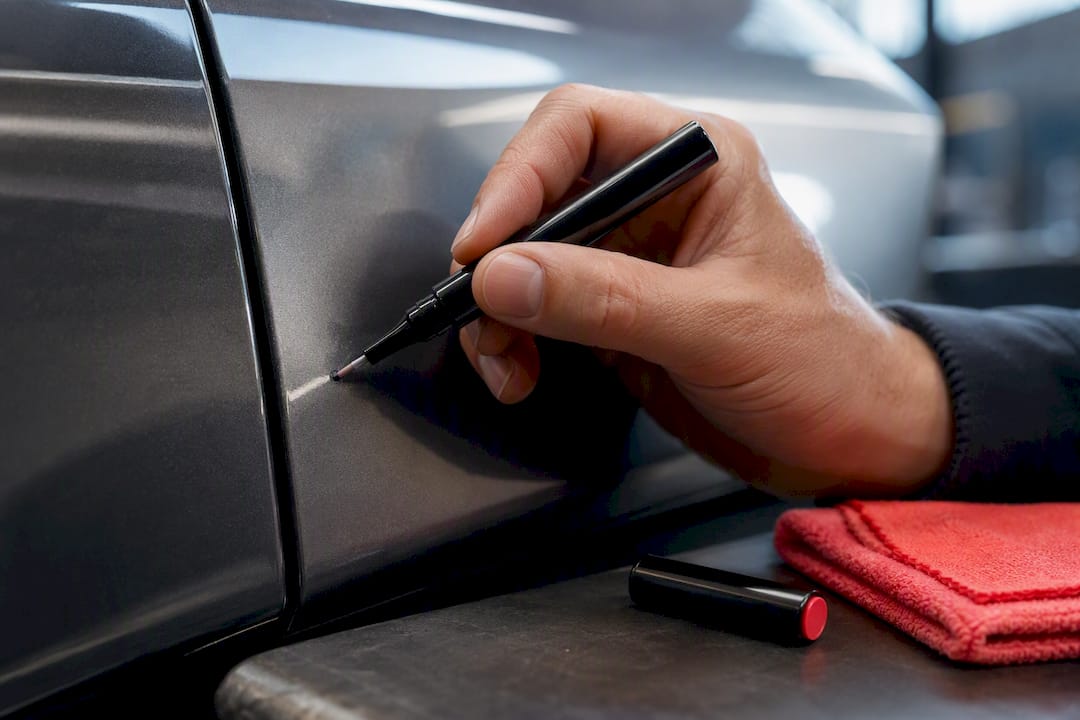
Pro Tip: A touch-up pen gives more control than a cotton swab or fingertip for small chips, since it lets you deposit a thin, even layer instead of a blob that dries into a bump.
Signs You Need a Full Repaint, Not Another Patch
Some damage patterns tell you a touch-up will fail before you even start. BEHR PRO’s guidance on touch-up versus repaint applies just as well to vehicles: once damage is widespread or the finish shows structural failure, patching stops making sense.
Watch for these signals:
- Peeling, bubbling, or flaking clear coat, which signals adhesion failure underneath
- Chalking or a dull, powdery surface across large sections of the car
- Fading that’s spread across multiple panels rather than one isolated spot
- Damage larger than roughly 12 to 18 inches across, where blending becomes nearly impossible
- Two or more prior touch-up attempts already visible on the same panel
Multiple touch-ups compound the problem instead of solving it. Each added patch introduces its own slight color and sheen variation, so a car with three or four touch-ups often looks worse than one with a single larger flaw. If you’re prepping the car for resale, buyers and appraisers notice patchwork finishes immediately, and it affects perceived value even when the mechanical condition is fine. A full repaint resets the panel to a single, uniform finish and gives you a durability baseline you can actually plan around.
Your Decision Checklist: Cost, Timeline, and What to Ask
Before you commit to either option, walk the car in daylight and check these points:
- Inspect the damaged area up close, then step back 6 feet and look again
- Hold a flashlight at a low angle across the panel to reveal texture or sheen differences
- Confirm the paint’s age and, if possible, the original paint code or can
- Count how many prior touch-ups exist on that panel or nearby panels
Cost and timeline hinge on a few variables:
- Prep work required. Rust removal, dent repair, and sanding add hours before any paint goes on.
- Area size. A single panel costs far less than a multi-panel or full-vehicle job.
- Material quality. Genuine manufacturer-matched paint costs more than generic rattle-can product but blends and lasts better.
- Access complexity. Panels requiring disassembly, like around trim or mirrors, add labor time.
Touch-ups typically take a few hours to a single day, largely drying time. Repaints run from several days to a couple of weeks depending on scope. EFC Contractors advises getting a written quote that names the exact scope, including a clause covering what happens if a touch-up attempt reveals it actually needs to become a repaint. That clause alone can save you an unpleasant cost surprise mid-job.
Professional Repaint Vs. DIY Touch-Up: What Gets Missed
Professional shops follow a sequence that’s easy to skip at home: clean, sand, address any corrosion or adhesion problems, prime, color match, apply the finish coats with proper spray technique, then clean up. That sequence is what makes a repaint hold up for years instead of months.
DIY touch-ups usually fail for predictable reasons:
- Skipping surface prep, so the new paint sits on contamination instead of a clean base
- Guessing at sheen instead of matching it, which shows immediately under raking light
- Applying too much paint at once, creating a raised, glossy patch instead of a flat blend
- Not testing the repair outdoors in direct sun before calling it finished
Pro Tip: If a repair still looks off in your garage under fluorescent light, check it again outside at midday. Sunlight exposes sheen mismatches that indoor lighting hides completely.
When 5starpainting handles a full repaint, a personal project manager oversees the job from prep through cleanup, genuine Nippon Paint goes on instead of a generic mix, and the work carries a warranty, so you’re not left guessing whether the finish will hold.
Aftercare: Making the Repair Actually Last
Whether you touched up a chip or repainted a full panel, the first few days matter most. Fresh paint needs time to cure fully, and washing or polishing too soon can trap moisture or dull the finish before it hardens. Temperature and humidity both slow or speed that curing window.
- Avoid automated car washes and heavy polishing for at least a week after painting
- Clean gently with a soft cloth and mild soap once cured
- Skip abrasive compounds near the repaired area for the first month
- Address any new small chips quickly, before dirt and moisture work into the exposed metal
Real Simple’s guidance on repaint cycles applies here too: occasional touch-ups slow deterioration, but once wear spreads across multiple areas, it’s usually time to plan a repaint rather than keep patching.
Why We Push for a Repaint When It’s the Right Call
We’d rather tell you upfront that a touch-up won’t hold than sell you a quick fix that looks patchy in six months. A car we recently reworked had three separate touch-ups on one door, each a slightly different shade under sunlight. A full repaint of that panel gave the owner one uniform finish backed by a real warranty, instead of a fourth mismatched patch. If you’re unsure which side of that line your car falls on, a free inspection settles it faster than guessing.
— Fabian
Get a Full Repaint Done Right the First Time
If your car needs more than a spot fix, a full repaint from 5starpainting gets you a uniform, durable finish instead of another patch that fades unevenly next to the last one. Every package covers proper surface prep, genuine Nippon Paint, a personal project manager watching the job from start to finish, full cleanup, and a one-year warranty, all built into one all-inclusive price with no hidden add-ons.

This approach makes the most sense once damage covers multiple panels, your finish is glossy enough to show every mismatch, or you’re prepping a vehicle surface ahead of a sale and need it to look consistent under any light, as explained in Painting Vs. Replacing Old Doors | One Day Doors & Closets. Homeowners tackling a related resale prep project can check the HDB painting service page or condo painting service page for pricing details, or head to the main service page to book a free inspection and get a written quote before committing to either fix.
Sources
- When To Touch Up Wall Paint or Repaint | BEHR PRO
- Touching Up: How To Blend Touch Up Paint | Dunn-Edwards
- How to touch up paint | Sherwin-Williams
- How often should you repaint? | Real Simple