
Water-based latex paint reaches full cure in about 14 to 30 days, oil and alkyd paints need 7 to 60 or more days, and two-part epoxy typically hits full chemical resistance in 7 to 30 days. Dry-to-touch is not the same thing as cured. A wall can feel completely dry within an hour and still be weeks away from full hardness.
The immediate action list is short. Ventilate the room for at least 72 hours after painting to clear lingering solvent odors, even once the surface feels dry. Avoid heavy contact, tape, or stacked furniture on high-touch surfaces like cabinets and doors for 7 to 14 days.
Here’s the quick reference most homeowners actually need:
- Latex/acrylic wall paint: touch-dry in 30 minutes to 1.5 hours, recoat in 4 to 6 hours, full cure in 14 to 30 days
- Oil/alkyd paint: touch-dry in 6 to 8 hours, recoat in 24 hours, full cure in 7 to 60+ days
- Two-part epoxy: walk-on hardness in 24 to 72 hours, full cure in 7 to 30 days
Quick fact: The gap between “dry” and “cured” is where nearly every paint job problem starts, from peeling tape to dented cabinet corners, because the surface looks finished long before the chemistry actually is.
Key Takeaways
Paint that feels dry to the touch within hours can still need weeks to reach full cure, and rushing recoats, hardware installation, or cleaning during that window causes most avoidable finish damage.
| Point | Details |
|---|---|
| Drying and curing are different | Touch-dry means solvent has left the surface; full cure means the film has reached final hardness, which takes days to weeks longer. |
| Full cure ranges vary by chemistry | Latex needs 14 to 30 days, oil/alkyd needs 7 to 60+ days, and two-part epoxy needs 7 to 30 days for full chemical resistance. |
| Ventilate for at least 72 hours | Solvent odor can persist after the surface feels dry, so keep airflow going even once paint looks finished. |
| Match patience to the surface | Walls tolerate moderate use within a week; cabinets, doors, and epoxy floors need the full cure window before heavy handling. |
| Professional sequencing manages risk | 5starpainting assigns a project manager to sequence rooms, control drying conditions, and apply genuine Nippon Paint under a one-year warranty. |
Table of Contents
- What’s the Difference Between Paint Drying and Curing?
- Cure Times by Paint Type: A Reference Table
- What Actually Speeds Up or Slows Down Curing?
- How Can You Tell If Paint Is Actually Cured?
- When Can You Recoat, Hang Pictures, or Move Furniture Back?
- Safe Ways to Speed Up Curing Without Ruining the Finish
- Mistakes That Slow Cure Time or Wreck the Finish
- Why Professional Timing Makes a Real Difference
- What Homeowners Get Wrong About Paint Curing Time
- A Straightforward Option When Cure Timing Gets Complicated
- Frequently Asked Questions
- Sources
What’s the Difference Between Paint Drying and Curing?
Drying and curing are two separate processes, even though they happen to the same coat of paint at the same time. Drying is water or solvent leaving the film. Curing is the paint forming a hard, durable surface through a chemical or physical process that can take weeks after the paint already looks finished.
A painted wall moves through five recognizable stages, and understanding them explains almost every timing question in this article.
- Wet film — paint is freshly applied and still fluid enough to show brush or roller marks.
- Tack-free — the surface no longer feels sticky to a light touch, usually within 30 minutes to a few hours.
- Dry-to-touch — you can touch the surface without leaving a fingerprint, though it’s still soft underneath.
- Dry-to-recoat — enough solvent or water has left the film that a second coat will bond properly instead of lifting the first.
- Full cure — the film has reached its final hardness, chemical resistance, and adhesion strength.
The chemistry behind these stages varies by paint type. Waterborne paints like latex cure through coalescence: tiny polymer particles suspended in water fuse together as the water evaporates, forming a continuous film. Alkyd and oil-based paints cure through oxidation, a slower reaction where the paint absorbs oxygen from the air and cross-links into a hard film. Two-part epoxies and polyurethanes cure through a chemical reaction between two separate components, similar to how epoxy glue hardens once mixed.
The solvents and mild odors you smell after painting aren’t a sign something went wrong. They’re evidence that coalescence is still happening beneath a surface that already feels dry, and that process can continue for weeks after the paint looks finished.
This is why a bedroom wall can feel bone dry the morning after painting yet still smell faintly of paint five days later. The tack-free surface locked in fast. The deeper coalescence, where remaining solvent works its way out of the film, moves much slower. Rushing furniture back against that wall or scrubbing it with a sponge during this window is one of the most common ways homeowners damage a fresh paint job without realizing it.
Cure Times by Paint Type: A Reference Table
Cure times differ enormously by paint chemistry, and knowing which category your project falls into changes how you should plan the rest of your week. The ranges below assume typical indoor conditions of roughly 68 to 77°F (20 to 25°C) and 40 to 60% relative humidity. Real homes rarely hold those numbers steady, so treat these as a baseline, not a guarantee.
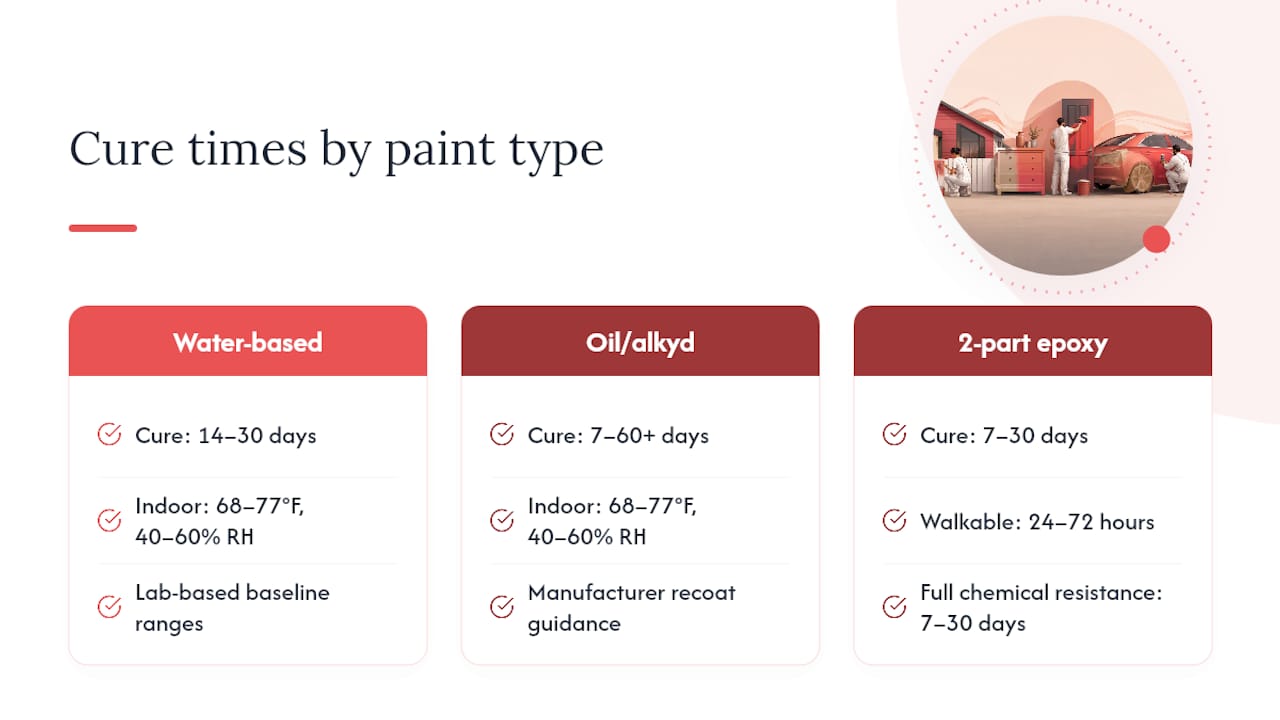
These figures line up with industry lab testing on multiple paint chemistries, and the recoat guidance for common household paints matches what most manufacturers print on the can. Manufacturers arrive at these numbers using standardized lab methods, including test standards like ISO 9117 for touch-dry measurement and ASTM D1640 and ASTM D5895 for drying and hardness development. Those tests run under controlled temperature and humidity, which is exactly why your bathroom on a humid August afternoon won’t behave like the lab.
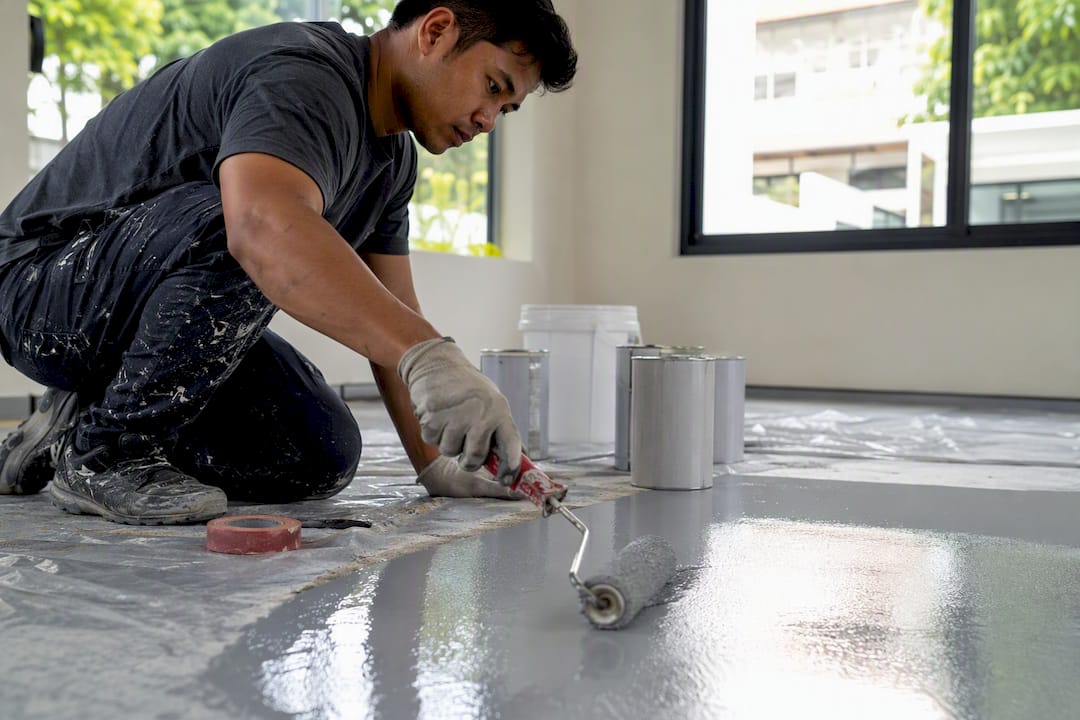
Two-part epoxy deserves a specific warning here. Epoxy floors often reach walk-on hardness within 24 to 72 hours, which tempts homeowners into treating the floor as finished. Full chemical resistance, the point at which the coating can handle hot tires, chemical spills, or heavy furniture without lifting, takes 7 to 30 days. Garage floor epoxy that looks perfectly cured on day three can still be soft enough underneath to scar under a hot tire.
If you’re deciding between paint chemistries for a specific room, it helps to understand the different types of paint before you buy, since sheen and formulation both affect how forgiving the cure window will be.
What Actually Speeds Up or Slows Down Curing?
Temperature governs almost everything about how fast a paint film coalesces or oxidizes. Below roughly 50°F (10°C), waterborne paints struggle to form a continuous film at all, and the surface can stay soft and vulnerable to marring for far longer than the label suggests. Above 85% relative humidity, moisture in the air competes with the paint’s own water content, stretching dry times and sometimes causing a hazy or uneven finish. The ideal window sits between 65 and 85°F (18 to 29°C) with humidity under 70%, which is achievable in most Singapore homes with air conditioning running during the paint job.
Airflow matters, but not in the way most people assume. A fan speeds up surface evaporation, which is helpful for eliminating tackiness, but it does nothing to accelerate the deeper coalescence happening inside the film. Blasting a wall with a box fan right after rolling on the final coat can actually cause the surface to skin over before the layer underneath has released its solvent, trapping moisture and weakening the final film.
Coat thickness and substrate porosity change the math further. A thick coat on a non-porous surface, like a glossy door, traps solvent longer than a thin coat on a porous drywall surface that can breathe. For two-part systems, the mixing ratio isn’t just a suggestion. Off-ratio epoxy or polyurethane can remain tacky indefinitely or cure into a brittle, weak film regardless of how long you wait.
- Keep the room between 65 and 85°F during application and for at least 48 hours after
- Run air conditioning or a dehumidifier rather than opening windows on a humid day
- Apply thin, even coats rather than one heavy coat to cut cure time meaningfully
- Follow manufacturer mixing ratios exactly for any two-part product, using a scale if the label specifies weight ratios
Pro Tip: Crack a window or run an exhaust fan for ventilation, but avoid pointing a fan directly at a freshly painted wall for the first few hours. Gentle airflow across the room clears fumes without skinning the surface prematurely.
How Can You Tell If Paint Is Actually Cured?
A handful of simple physical tests will tell you more about your wall’s real condition than staring at the calendar. None of them require special tools.
- The fingernail test. Press a fingernail lightly against an inconspicuous spot. If it leaves a mark or feels soft, the film hasn’t reached dry-to-recoat hardness yet. Press gently. This test can dent a genuinely dry surface if you’re rough with it.
- The tack-free check. Touch the surface with a clean, dry finger. If nothing transfers and the surface doesn’t feel sticky, you’ve cleared the earliest stage, though this tells you nothing about deeper cure.
- The scratch or indent test. For surfaces about to take hardware, like a cabinet door getting a new hinge, press a coin edge lightly against a hidden area. If it dents or scratches easily, hold off on installing hardware or heavy adhesive.
- Check the technical data sheet. Every can of paint has manufacturer-published cure times, and these numbers reflect real lab testing under standardized conditions for that exact formula. The TDS is more reliable than any homeowner test, because it accounts for the paint’s specific resin chemistry.
Lingering odor deserves its own mention. A faint paint smell a week after the job usually means coalescing solvent is still evaporating out of the film, not that something went wrong. Keep the room ventilated until the smell fades completely, which for most latex paints happens well within the 72-hour window recommended for VOC management. If a strong odor persists past two weeks, the room may need more airflow than it’s currently getting.
When Can You Recoat, Hang Pictures, or Move Furniture Back?
Every homeowner asks some version of the same question after a paint job: when can life go back to normal? The honest answer depends on which surface and which action you’re talking about.
- Recoating walls: wait 4 to 6 hours for latex, a full 24 hours for oil-based or alkyd paint. Many professional painters wait until the next day regardless of paint type, since overnight cure produces a noticeably better final finish than a same-day second coat.
- Recoating trim and cabinets: wait the full 24 hours even for waterborne formulas, since these surfaces get handled constantly and any softness in the film will show up as fingerprints or drag marks.
- Hanging pictures or switch plates: nail or screw-based hardware is generally fine after 7 days on walls. Adhesive-backed hooks or strips need the fuller cure window, closer to 14 days, because the adhesive bond depends on the paint film being fully hardened underneath.
- Moving furniture back: light furniture placement is usually fine after 24 to 48 hours, but avoid pushing or dragging pieces against walls for at least a week to prevent scuffing a still-soft film.
- Stacking doors or cabinet fronts: never stack painted doors flat against each other before the full cure window closes. Even light pressure can permanently bond two painted surfaces together.
- Foot traffic on painted floors or decks: light socked-foot traffic after 24 hours, normal shoe traffic after 3 to 5 days, and no furniture drag or rugs for a full 2 weeks.
- Cleaning painted surfaces: hold off on washing walls or wiping down cabinets with soap and water for at least 14 days, since early cleaning can dull the finish or lift the film before it’s fully hardened.
If you’re painting a ceiling as part of the same job, the same recoat math applies, though the technique for even ceiling coverage affects how thick each coat ends up, which in turn shifts your recoat timing slightly later than a thin wall coat.
Safe Ways to Speed Up Curing Without Ruining the Finish
You can shave real time off a cure schedule, but only within limits the paint chemistry allows. Push past those limits and you risk a soft, tacky, or uneven finish that takes longer to fix than the time you saved.
- Keep the room at a steady 70 to 75°F rather than letting it swing between hot days and cool, air-conditioned nights
- Run a dehumidifier if ambient humidity climbs above 60%, especially during Singapore’s wetter months
- Provide gentle, indirect airflow across the room rather than aiming a fan directly at the wet surface
- Apply two thin coats rather than one thick coat, since thinner films release solvent faster and more evenly
- Stick to the manufacturer’s stated recoat window exactly. Recoating early traps solvent under the new layer and recoating late can cause adhesion problems between coats
Trade-grade accelerators exist for specific applications, mostly in industrial and commercial coating work where a fast turnaround justifies specialized additives. These products are formulated for specific resin systems and typically require professional handling. Adding a random additive to a can of retail latex paint to “speed things up” almost always backfires, causing uneven sheen or premature failure.
Pro Tip: Never use a space heater or hair dryer to force-dry a fresh coat. Rapid surface heating can cause thermal shock, where the outer film skins over while trapped solvent underneath causes bubbling or wrinkling that only shows up days later.
Mistakes That Slow Cure Time or Wreck the Finish
Most cure-related paint failures trace back to a handful of repeated homeowner errors, and nearly all of them are avoidable once you know what to watch for.
- Recoating too soon. Applying a second coat before the first has released enough solvent causes the roller to drag, pull, or streak the fresh layer underneath, creating a mottled finish that’s difficult to fix without sanding back to bare surface.
- Skipping proper surface prep. Painting over dust, grease, or a damp substrate traps moisture beneath the film, which weakens adhesion and can cause peeling months later even though the paint looked fine on day one.
- Using spot heaters near wet paint. Direct heat causes uneven film formation, and the resulting thermal shock often produces wrinkling or bubbling that only becomes visible after the surface has fully dried.
- Mixing two-part products incorrectly. Off-ratio epoxy or polyurethane can stay tacky indefinitely, and once the pot life expires, the material won’t cure properly no matter how long you wait.
- Painting in poor ventilation. Stagnant air slows solvent release and extends every stage of the cure timeline, particularly in enclosed spaces like bathrooms or walk-in closets.
Why Professional Timing Makes a Real Difference
Professional painters treat curing as a scheduling problem, not just a chemistry problem. On a multi-room job, sequencing low-touch areas first and finishing high-touch fixtures like doors and cabinet fronts last builds in a natural cushion, so by the time a family moves back into a room, the surfaces that get touched most have had the longest to cure.
That kind of planning depends on controlling the variables covered earlier in this article: room temperature, humidity, airflow, and coat thickness, all managed at once across several rooms rather than one wall at a time.
Getting cure time right on a single wall is straightforward. Getting it right across an entire flat, with different paint types on doors, cabinets, and ceilings all curing on different clocks, is where experience actually pays off.
5starpainting brings that experience to every job, backed by more than 30 years in residential painting. Every project includes:
- Genuine Nippon Paint products matched to the specific surface and finish requirements
- A personal project manager who sequences rooms and manages drying conditions throughout the job
- Meticulous surface preparation that prevents the trapped-moisture problems described earlier
- A one-year warranty that reflects confidence in how the finish holds up once fully cured
For cure-sensitive work like kitchen cabinets or a full condo repaint, that kind of oversight is difficult to replicate on a DIY timeline squeezed into a few weekends.
What Homeowners Get Wrong About Paint Curing Time
Most cure time advice online treats the topic like a single number you can memorize, and that’s the first mistake. A latex wall and an epoxy garage floor don’t play by the same rules, and treating them the same is how homeowners end up dinging a cabinet door they assumed was “done” after 24 hours.
The conventional advice to “wait 24 hours and you’re fine” gets the recoat window roughly right and the full cure window badly wrong. That gap is exactly where damage happens: not on day one, but on day five or six, when confidence outpaces the actual chemistry.
If there’s one thing worth prioritizing, it’s matching your patience to the surface. Walls can take moderate use within a week. Cabinets, doors, and anything epoxy-coated need the full window, no shortcuts. For a single wall, that’s an easy rule to follow yourself. For an entire home with mixed finishes on different clocks, that’s exactly the kind of sequencing where hiring it out stops being a luxury and starts being the more sensible option.
A Straightforward Option When Cure Timing Gets Complicated
Juggling cure windows across a whole flat, where cabinets, doors, ceilings, and walls are all curing on different schedules, is where DIY plans usually slip. 5starpainting takes that scheduling problem off your plate entirely, sequencing rooms and finishes so nothing gets touched, stacked, or handled before it’s actually ready.

Every job includes genuine Nippon Paint products, full surface preparation, furniture protection, post-job cleanup, and a personal project manager assigned to your home from start to finish, all under one all-inclusive price with no hidden fees. That last part matters most on cure-sensitive work: kitchen cabinets, interior doors, and multi-room repaints where getting the timing wrong on one surface can mean redoing it. A one-year warranty backs the finish once everything has fully cured.
If you’re planning a repaint in an HDB flat or a condo unit, have your unit size, room count, and target start date ready when you reach out. Request a quote through 5starpainting and get a project manager assigned before the first coat goes on.
Frequently Asked Questions
How long does interior paint take to dry before you can recoat?
Most latex wall paint is ready to recoat in 4 to 6 hours under normal indoor conditions. Oil-based and alkyd paints need closer to 24 hours. Many professional painters wait until the next day regardless of paint type, since overnight cure produces a cleaner finish than a same-day second coat.
Is paint drying time the same as paint curing time?
No. Drying refers to solvent or water leaving the film, which can happen within hours. Curing is the chemical or physical hardening process that follows, and it can take anywhere from 7 to 60 or more days depending on the paint type.
What factors affect paint curing the most?
Temperature and humidity have the biggest impact. Cure slows significantly below 50°F (10°C) or above 85% relative humidity, and coat thickness plus substrate porosity also shift the timeline meaningfully.
How can you tell if paint is fully cured?
Press a fingernail gently against an inconspicuous spot; if it leaves a mark, the film hasn’t fully hardened. For a definitive answer, check the paint’s technical data sheet, which lists manufacturer-tested cure times for that specific formula.
When is it safe to wash freshly painted walls?
Wait at least 14 days before washing walls or wiping down cabinets with soap and water, giving the film time to reach full hardness so cleaning doesn’t dull or lift the finish.
Does two-part epoxy cure faster than regular paint?
Epoxy reaches walk-on hardness in 24 to 72 hours, which is fast, but full chemical resistance still takes 7 to 30 days. Treating an epoxy floor as finished after a day or two is a common and costly mistake.
Sources
- Paint Drying and Curing: A Journey to Flawless Finish
- Dry time vs cure time: Why ‘dry to touch’ doesn’t mean ready
- How Long Should Paint Dry Between Coats? 2-24 Hours
- Your Guide To Painting The Ultimate Eco-friendly Home